
act101
act101 lets your team's AI agents refactor, port, and analyze code across 163 languages with one secure, local binary.
Visit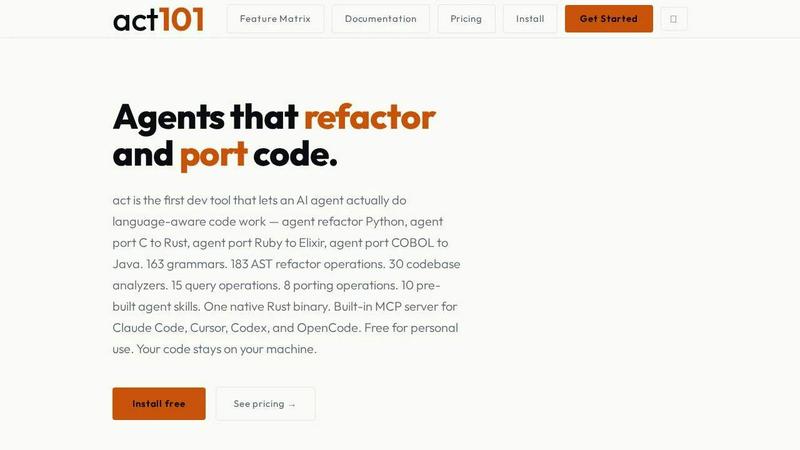
About act101
act101 is a groundbreaking developer tool that fundamentally changes how AI agents interact with code. It is the first dev tool that lets an AI agent actually perform language-aware code work, including refactoring and porting across an impressive 163 programming languages. At its core, act101 is a Model Context Protocol (MCP) server that exposes 183 AST-aware refactor operations, 30 codebase analyzers, 15 query operations, and 8 porting operations to AI coding agents like Claude Code, Cursor, Codex, and OpenCode. This tool is built for development teams who want their AI agents to move beyond simple code generation and into precise, structural code transformations. The main value proposition is that act101 enables collaborative human-AI workflows where the agent handles complex refactoring and migration tasks with AST-level precision, automatic checkpointing, and instant undo capabilities. Your code stays on your machine with no telemetry, making it a secure choice for enterprise teams. The entire tool is a single native Rust binary with no plugin runtime, no package graph, and no supply-chain attack surface. It works without indexing, caching, or cold starts, parsing on call so results are never stale.
Features of act101
183 AST Refactor Operations for AI Agents
act101 provides a comprehensive library of 183 AST-aware refactor operations that your AI agent can call directly. These operations include extract-function, rename, move-symbol, convert-to-dataclass, extract-trait, inline, and 177 more. Each operation works across the entire codebase with cross-file consistency and full awareness of the abstract syntax tree. This means your agent can make precise, structural changes without the risk of breaking formatting, losing comments, or introducing errors that come with whole-file rewrites. Every operation includes automatic checkpointing and instant undo, creating a collaborative safety net for your team.
8 Porting Operations for Cross-Language Migration
act101 revolutionizes language migration with a structured state machine approach. The tool provides port_contract to anchor source-to-target migration, port_inventory to enumerate every symbol that must move, port_order to resolve dependency ordering, and a port_manifest state machine with init, add, update, remove, and note operations to track progress step by step. This systematic approach works between any two of the 163 supported grammars, enabling your AI agent to port C to Rust, Ruby to Elixir, COBOL to Java, and countless other combinations with confidence and traceability.
30 Codebase Analyzers for Deep Understanding
Your team can leverage 30 built-in codebase analyzers that give AI agents a structural map of the repository before touching a single line. These analyzers cover cohesion, coupling, cycles, chokepoints, hotspots, dead code, layers, seams, clusters, surface area, fan balance, migration readiness, type completeness, and more. By providing this deep structural understanding, act101 enables your AI agent to make informed decisions about where to focus refactoring efforts, which areas are most critical for migration, and how changes will impact the overall architecture.
10 Pre-Built Agent Skills for Common Workflows
act101 comes with 10 pre-built agent skills that compose operations into common engineering workflows. These skills include architecture-audit, code-review, refactoring, code-navigation, code-generation, migration-assessment, boundary-analysis, change-impact, health-check, and architectural-refactoring. Your team can invoke these skills with simple commands like /skill-name in Claude Code, Cursor, or other MCP-aware clients. This creates a collaborative environment where developers and AI agents work together on complex tasks with minimal setup and maximum efficiency.
Use Cases of act101
Large-Scale Codebase Refactoring
Development teams can collaborate with AI agents to refactor large, complex codebases across 163 languages. For example, a team working on a Python monolith can have their agent extract functions, rename symbols across the entire workspace, convert classes to dataclasses, and organize imports with AST-level precision. The automatic checkpointing and instant undo features ensure that every change is reversible, allowing the team to explore refactoring strategies without fear of breaking the codebase. This use case is ideal for teams modernizing legacy systems or improving code quality across multiple projects.
Cross-Language Code Migration
Organizations migrating from one programming language to another can use act101 to automate the process systematically. A team porting C code to Rust can have their agent use the contract, inventory, ordering, and manifest state machine to track every symbol that must move, resolve dependency ordering, and monitor progress step by step. This structured approach ensures that no code is left behind during migration, and the agent can handle complex edge cases that would be tedious and error-prone for humans. This use case is perfect for companies modernizing their technology stack while maintaining business continuity.
Architecture and Code Quality Audits
Engineering teams can collaborate with AI agents to perform comprehensive architecture audits and code quality assessments. Using the 30 codebase analyzers, the agent can identify coupling issues, cyclic dependencies, dead code, hotspots, and boundary violations across the entire repository. The pre-built architecture-audit and health-check skills compose these analyses into actionable reports that help teams prioritize technical debt, plan refactoring sprints, and maintain healthy codebases. This use case is invaluable for teams practicing continuous improvement and architectural governance.
Automated Code Review and Change Impact Analysis
Development teams can integrate act101 into their code review workflows to get deeper insights into proposed changes. The code-review skill allows the AI agent to analyze pull requests for potential issues, while the change-impact skill identifies how modifications will affect other parts of the codebase. This collaborative approach helps teams catch problems early, understand the full scope of changes, and make more informed decisions about merging code. This use case is particularly valuable for large teams working on interconnected systems where changes can have far-reaching consequences.
Frequently Asked Questions
How does act101 ensure my code stays private and secure?
act101 is built as a native Rust binary that runs entirely on your machine. There is no telemetry, no data collection, and your code never leaves your environment. The only exception is license verification, which may contact act101 servers to validate your license key. The tool has no plugin runtime, no package graph, and no supply-chain attack surface, making it a secure choice for teams working with sensitive or proprietary code. Your code stays on your machine at all times.
What AI coding agents and tools are compatible with act101?
act101 is MCP-native and works with any MCP-aware client. This includes Claude Code, Cursor, Windsurf, Codex, and OpenCode. The tool exposes a built-in MCP server that these agents connect to, providing them with all 183 refactor operations, 30 analyzers, 15 query operations, and 8 porting operations. Your team can use their preferred AI coding tool while gaining access to act101s powerful code manipulation capabilities.
How does act101 handle cross-file consistency during refactoring?
act101 uses AST-aware operations that maintain cross-file consistency automatically. For example, when you rename a symbol across a Rust workspace, the tool updates all references throughout the codebase. When you move a TypeScript module, every import statement is updated to reflect the new location. Each operation includes automatic checkpointing, and if anything looks wrong, you can instantly undo the change. This ensures that your codebase remains consistent and functional throughout the refactoring process.
What is the performance impact of using act101 on large codebases?
act101 is designed for performance with no indexing, no caching, and no cold start. It parses code on call, meaning results are never stale and there is no initial setup overhead. The tool is a single native Rust binary that benchmarks at approximately 85% fewer tokens than file-based operations. This efficiency means your AI agent can work faster and more cost-effectively, even on large codebases with millions of lines of code across multiple languages.
Pricing of act101
act101 is free for personal use. For team and enterprise pricing, please visit the act101 pricing page on their website to see current plans and tiers. The personal use tier gives you full access to all 163 grammars, 183 AST refactor operations, 30 codebase analyzers, 15 query operations, 8 porting operations, and 10 pre-built agent skills. This makes it accessible for individual developers and small teams to start collaborating with AI agents on code refactoring and migration projects immediately.
Similar to act101


Toolvero
Free Online Tools Built With Privacy in Mind


laya.tools
A free directory of 950+ projects built on Laya, the open-source decision model. Updated daily.
Sprite Sheet Maker
A free browser-based toolkit for creating, cutting, converting, and previewing sprite sheet animations.

Forms Plugin
The #1 Native Form Builder Plugin for Framer - No Code, No Embeds, No External Platforms.