
LLMWise vs SVG to 3D
Side-by-side comparison to help you choose the right product.

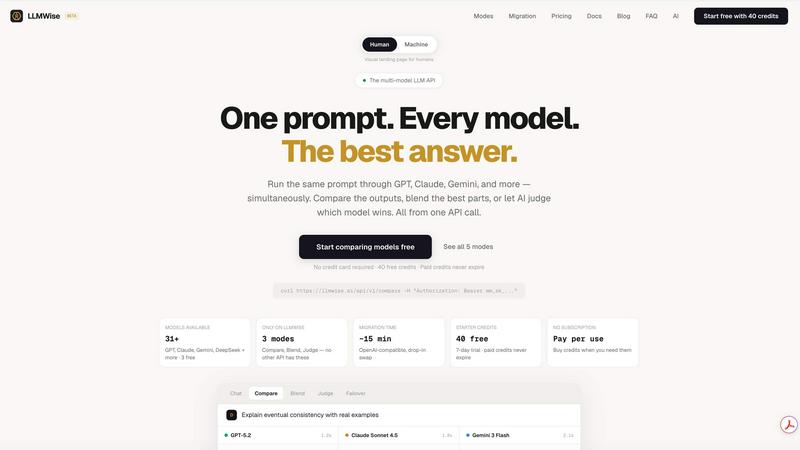
Unify your team's AI tools with one smart API that automatically picks the best model for every task.
Last updated: February 28, 2026
SVG to 3D
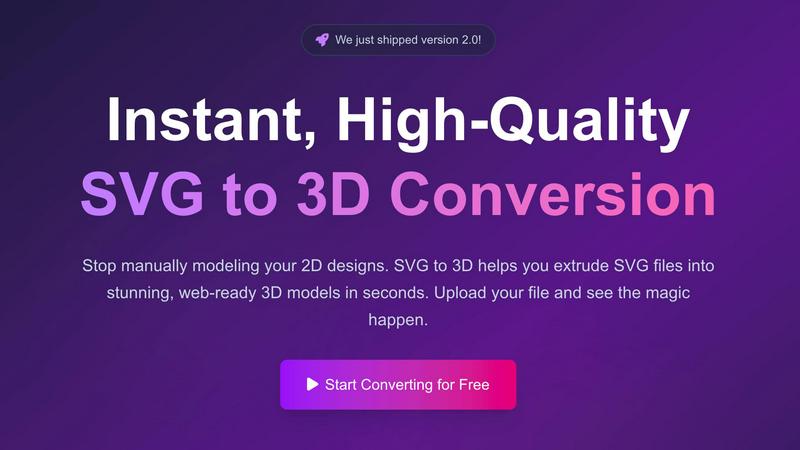
Easily transform your SVG designs into stunning, professional 3D models in seconds with SVG to 3D.
Last updated: February 28, 2026
Visual Comparison
LLMWise
SVG to 3D
Feature Comparison
LLMWise
Intelligent Model Routing
LLMWise's smart routing acts as your AI conductor, analyzing each prompt and automatically directing it to the most suitable model from its vast catalog. This means code generation tasks are sent to the best coding model, creative briefs to the most eloquent writer, and analytical questions to the most logical reasoner. This feature removes the guesswork and manual switching between different provider dashboards, allowing your team to focus on building great products instead of managing AI infrastructure.
Compare, Blend, and Judge Modes
This suite of orchestration tools empowers teams to harness the collective intelligence of multiple models. Compare mode runs a single prompt across several models simultaneously, presenting their answers side-by-side with metrics on speed, cost, and length for easy evaluation. Blend mode takes this further by synthesizing the best parts of each model's output into one superior, cohesive answer. Judge mode enables models to critique and evaluate each other's responses, providing an automated layer of quality assurance.
Resilient Circuit-Breaker Failover
LLMWise ensures your application's AI capabilities never break. It includes an intelligent circuit-breaker system that monitors all connected providers in real-time. If a primary model or provider experiences high latency or an outage, traffic is instantly and automatically rerouted to a predefined backup model. This built-in redundancy guarantees high availability and reliability for production applications, giving your team and your users uninterrupted service.
Advanced Testing & Optimization Suite
Teams can systematically improve their AI implementations with LLMWise's built-in testing tools. Create benchmark suites and run batch tests across models to measure performance on your specific prompts. Set optimization policies that automatically prioritize speed, cost, or accuracy for different types of requests. Automated regression checks help ensure that updates to models or prompts don't degrade the quality of your outputs, fostering a culture of continuous improvement and stable deployments.
SVG to 3D
One-Click to GLB for the Web
This feature enables users to export their 3D models in GLB format with just a single click. The GLB files generated are optimized for web use, making them perfect for integration into Three.js or React Three Fiber projects. This functionality ensures that developers can effortlessly add interactive 3D elements to their websites without complicated processes.
3D-Print Ready
SVG to 3D supports clean STL exports, allowing users to prepare their 3D models for 3D printing directly. This feature is especially beneficial for those who wish to take their 2D designs into the physical realm, providing a straightforward way to go from digital artwork to tangible products without needing complex CAD software.
Fine-Tune Every Detail
With advanced controls, users can go beyond simple extrusion and fine-tune every aspect of their 3D model. Adjusting thickness, adding bevels, and applying realistic PBR materials are all possible, along with a real-time preview that allows for immediate feedback. This level of customization ensures that the final output meets professional standards.
Advanced Material System
SVG to 3D includes an advanced material system that allows users to apply realistic PBR materials, custom textures, and professional lighting effects to their models. This feature enhances the visual appeal of the 3D creations, helping them stand out in various applications, from web use to presentations.
Use Cases
LLMWise
Development and Prototyping
Developers can rapidly prototype AI features using the 30 permanently free models available at zero cost. This allows teams to experiment with different model capabilities, test prompt effectiveness, and build proof-of-concepts without any financial commitment. The compare mode is invaluable for debugging prompt issues by instantly seeing how different models interpret the same instruction, saving hours of trial and error.
Production Application Resilience
For teams running customer-facing AI applications, LLMWise's failover routing is critical. It ensures that if a primary AI service like GPT-4 has an outage, user requests are seamlessly handled by a backup model like Claude or Gemini, preventing downtime and maintaining a positive user experience. This turns a potential crisis into a minor, automated blip that your operations team doesn't need to manually manage.
Cost-Optimized AI Operations
Companies with existing API credits from major providers can use LLMWise's BYOK (Bring Your Own Keys) feature to plug in their keys and immediately benefit from smart routing and failover without changing their billing setup. This synergy between existing investments and new orchestration capabilities can lead to significant cost reductions, often over 40%, by ensuring the most cost-effective model is used for each task.
Content Creation and Evaluation
Marketing and content teams can use the blend and judge modes to produce higher-quality drafts. A single request can generate variations from multiple creative models, then synthesize the strongest elements into a final piece. Judge mode can then provide automated feedback on tone, clarity, and alignment with brand guidelines, creating a collaborative workflow between human creativity and AI assistance.
SVG to 3D
Create Interactive 3D Logos and Icons for Web
Web developers can easily convert SVG icons into interactive 3D models, enhancing their web projects with visual depth and engagement. This use case is particularly valuable for creating unique user interfaces that capture attention and elevate the user experience.
From Digital Design to Physical Object
Artists and designers can utilize SVG to 3D to transform their 2D designs into physical objects through 3D printing. This use case allows for the creation of custom parts, art pieces, and prototypes without the need for extensive modeling skills or software, making it accessible for all.
Enhance Your Website with Depth
By integrating 3D models into UI/UX designs, designers can present their concepts with greater depth and realism. This approach not only impresses clients but also allows stakeholders to visualize the final product more effectively, fostering better collaboration and decision-making.
Developer-Friendly Exports
SVG to 3D serves as an invaluable tool for developers looking to streamline their workflow. With the ability to export models in various formats like GLB, GLTF, OBJ, and STL, this tool ensures compatibility with popular 3D frameworks and engines, making it versatile for different project needs.
Overview
About LLMWise
LLMWise is the ultimate orchestration platform for developers and teams building with large language models. It eliminates the complexity of managing multiple AI providers by offering a single, unified API to access over 62 models from 20 leading providers, including OpenAI, Anthropic, Google, Meta, xAI, and DeepSeek. The core value proposition is intelligent, task-based routing: you send a prompt, and LLMWise automatically selects the optimal model for the job, whether it's coding with GPT, creative writing with Claude, or translation with Gemini. This collaborative approach ensures you always get the best possible output without vendor lock-in.
Built for developers who demand performance and reliability, LLMWise goes beyond simple routing with powerful orchestration modes like side-by-side comparison, output blending, and model-judged evaluations. It ensures your applications are always resilient with automatic failover routing if a provider experiences downtime. With a flexible, credit-based pricing model and the option to bring your own API keys (BYOK), teams can significantly reduce costs while gaining unparalleled flexibility. Start with 20 free credits and access 30 permanently free models to prototype, test, and build with zero commitment.
About SVG to 3D
SVG to 3D is a revolutionary web-based tool designed to seamlessly transform 2D SVG vector graphics into stunning, high-quality 3D models. This innovative solution addresses a common challenge faced by designers, developers, and 3D printing enthusiasts: the cumbersome and time-consuming process of using heavyweight software like Blender or C4D for simple tasks such as extruding logos or icons. By providing a streamlined platform where users can upload their SVG files and witness instantaneous conversion into 3D models, SVG to 3D simplifies workflows and enhances productivity. Its main value proposition lies in its user-friendly interface, advanced customization options, and the ability to export in multiple formats, catering to professionals who demand quality without sacrificing speed.
Frequently Asked Questions
LLMWise FAQ
How does the pricing work?
LLMWise uses a simple, pay-as-you-go credit system with no monthly subscriptions. You start with 20 free trial credits that never expire. After that, you purchase credit packs. You are only charged credits when you use a paid model; the 30 free models always cost 0 credits. You also have the option to use your own existing API keys from providers (BYOK), in which case you pay the provider directly at their rates and only use LLMWise credits for the orchestration features.
What are the free models for?
The 30+ free models serve multiple strategic purposes. They are perfect for initial prototyping and development, allowing you to build and test without cost. They act as a smart fallback layer for non-critical traffic or during retries if paid models fail. They are also essential for benchmarking, enabling you to compare the quality and performance of free versus paid models on your specific tasks before deciding where to route production traffic.
How quickly can I integrate LLMWise?
You can be up and running in under two minutes. The process involves signing up for an account to receive your free credits, generating a single API key from your dashboard, and then making your first request using the provided Python/TypeScript SDKs or cURL examples. This unified API approach means you replace multiple provider-specific integrations with one simple connection.
What happens if a model provider is down?
LLMWise's circuit-breaker failover system handles this automatically. The platform continuously monitors the health and latency of all connected model providers. If a primary model becomes unavailable or too slow, the system instantly reroutes your application's requests to a pre-configured backup model from a different provider. This ensures your application's AI features remain operational without any manual intervention required from your team.
SVG to 3D FAQ
How do I get started with SVG to 3D?
To begin converting your designs, simply upload your SVG file through the intuitive interface. You can drag and drop your file or paste the SVG code directly into the editor.
What file formats can I export my 3D model in?
SVG to 3D allows you to export your 3D models in several formats, including GLB, GLTF, OBJ, and STL, catering to various applications, from web integration to 3D printing.
Is there a limit on the size of SVG files I can upload?
Yes, the maximum file size for SVG uploads is 5 MB. This limit ensures that the processing remains fast and efficient while still accommodating a wide range of designs.
Is my design secure when using SVG to 3D?
Absolutely. Your files are processed locally in your browser whenever possible, ensuring that your designs remain private and secure without being uploaded to external servers.
Alternatives
LLMWise Alternatives
LLMWise is a unified API platform in the AI assistants category, designed to give developers a single access point to leading large language models like GPT, Claude, and Gemini. Its core innovation is intelligent auto-routing, which automatically selects the best-suited model for each specific prompt to optimize performance. Users often explore alternatives for various reasons, such as different pricing structures, the need for specific platform integrations, or a desire for a different set of management and testing features. Some teams may prioritize a different balance between cost, control, and convenience. When evaluating other solutions, it's wise to consider your team's primary needs. Key factors include the flexibility of the API, the depth of analytics and testing tools, the robustness of failover systems, and the overall pricing model. The goal is to find a tool that enhances your team's collaborative workflow without adding unnecessary complexity.
SVG to 3D Alternatives
SVG to 3D is a specialized tool designed to convert 2D SVG vector graphics into high-quality 3D models, making it an invaluable asset for developers, designers, and 3D printing enthusiasts. As part of the AI Assistants category, it offers a streamlined approach that eliminates the need for heavyweight software, allowing users to quickly transform their designs with ease. However, users often find themselves seeking alternatives for various reasons, including pricing concerns, specific feature requirements, or compatibility with different platforms. When exploring alternatives, it’s essential to consider factors such as the ease of use, export formats supported, real-time editing capabilities, and overall integration with existing workflows to ensure that the chosen solution meets their unique needs.