CCAPI vs HookMesh
Side-by-side comparison to help you choose the right product.

CCAPI
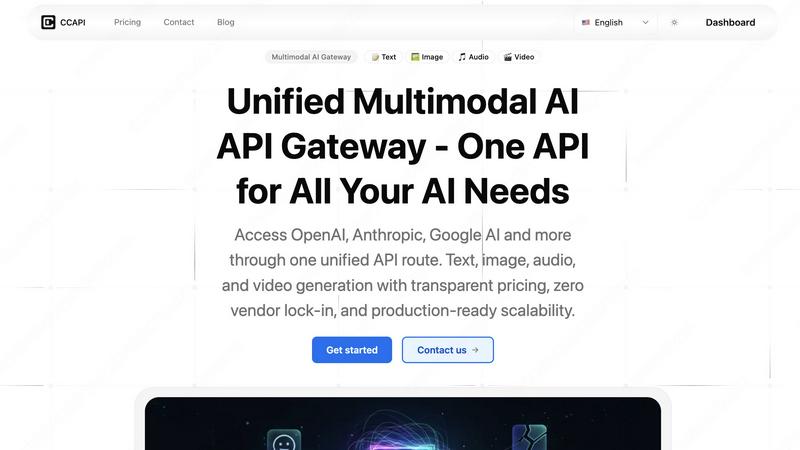
One unified API gateway that seamlessly connects your team to every major AI model.
Last updated: February 28, 2026

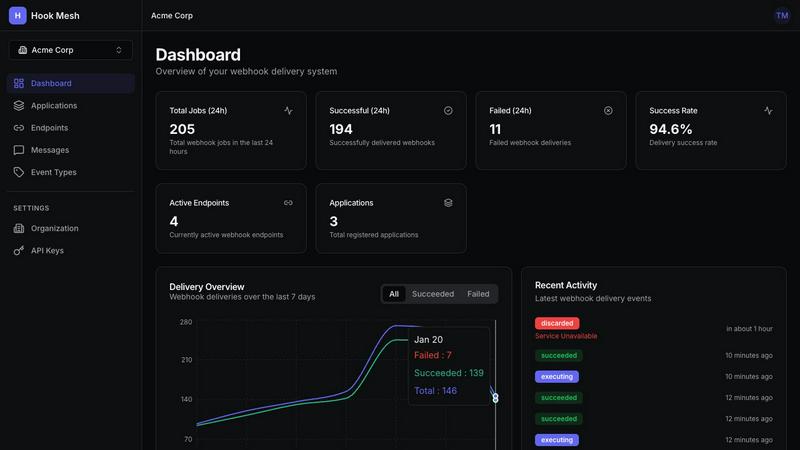
Effortlessly enhance your SaaS with reliable webhooks, automatic retries, and a self-service customer portal.
Last updated: February 28, 2026
Visual Comparison
CCAPI
HookMesh
Feature Comparison
CCAPI
Unified Multimodal API Gateway
CCAPI consolidates access to over seven major AI providers and four modalities—text, image, audio, and video—through a single, streamlined API endpoint. This means your team no longer needs to juggle different SDKs, authentication methods, or request formats for each service. Whether you're generating a chat response with Claude, creating an image with Stable Diffusion, or producing a video with Kling 3.0, you use the same consistent interface. This unification fosters seamless collaboration within development teams, as everyone works from the same integrated platform, drastically reducing integration complexity and accelerating feature development.
Intelligent Auto-Failover & Smart Routing
This feature ensures your application's resilience and high availability through intelligent routing logic. When CCAPI detects an issue like a timeout or failure from a primary provider (e.g., OpenAI), it automatically and swiftly reroutes the request to a backup provider (e.g., Anthropic or Google AI) in approximately 120 milliseconds. This smart failover happens under the hood, requiring zero intervention from your team. It guarantees a 99.9% success rate for API calls, allowing your team to build and maintain reliable, production-grade applications that your users can depend on, no matter the state of any single AI service.
OpenAI-Compatible Endpoint
Designed for effortless adoption, CCAPI offers a fully OpenAI-compatible endpoint. This allows developers to integrate with just one line of code change—simply swapping the base URL in their existing OpenAI SDK configuration. Your current code for chat completions, embeddings, and other tasks works instantly with CCAPI, providing immediate access to a broader model catalog. This dramatically lowers the barrier to entry and enables teams to collaborate on enhancing their AI capabilities without undergoing a costly and time-consuming migration or retraining process.
Transparent Usage Dashboard & Pay-As-You-Go
CCAPI promotes financial clarity and collaborative budget management with a real-time usage dashboard. Teams can monitor costs, latency metrics, and success rates across all providers and models in one place. The pricing model is straightforward pay-as-you-go; you add USD balance and are charged only for what you use, with no subscription fees or credit gimmicks. This transparency allows engineering, product, and finance teams to work together effectively, understanding exactly where resources are consumed and optimizing costs without any hidden surprises.
HookMesh
Reliable Delivery
HookMesh guarantees that webhook events are never lost, thanks to its automatic retry mechanism. It employs exponential backoff with jitter, retrying up to 48 hours to ensure successful delivery. This feature is instrumental in maintaining robust communication between your application and your users.
Circuit Breaker
The circuit breaker feature automatically disables failing endpoints and re-enables them once they recover. This proactive approach minimizes the risk of a single slow customer endpoint affecting the entire queue, ensuring that webhook deliveries remain uninterrupted.
Customer Portal
The embedded customer portal offers a self-service solution for users to manage their endpoints effortlessly. It provides delivery logs for full request and response visibility, allowing users to trace and troubleshoot delivery issues effectively. The one-click replay option also enhances user experience by enabling instant retries for failed deliveries.
Developer Experience
HookMesh is built with developers in mind, featuring a comprehensive REST API and SDKs for popular programming languages such as JavaScript, Python, and Go. This makes it incredibly easy to integrate webhook functionality into applications with just a few lines of code, allowing teams to ship webhooks in minutes.
Use Cases
CCAPI
Building Resilient AI-Powered Applications
Development teams use CCAPI to ensure their customer-facing applications never experience downtime due to AI provider issues. For instance, a SaaS platform offering AI writing assistance can rely on CCAPI's smart routing to automatically switch from GPT-5 to Claude or Gemini if one service has an outage. This failover capability is handled seamlessly, ensuring end-users receive continuous, uninterrupted service, which is critical for maintaining trust and satisfaction in production environments where reliability is non-negotiable.
Rapid Prototyping with Multiple AI Models
Product and R&D teams leverage CCAPI to rapidly prototype and compare different AI models without changing their codebase. A team building a new feature can quickly test prompts against Claude 4.6 for quality, GPT-5.2 for popularity, and DeepSeek V4 for cost-efficiency—all through the same API call by simply changing the model parameter. This fosters an experimental and collaborative development culture, allowing teams to efficiently evaluate which model delivers the best performance for their specific use case before committing to a full-scale implementation.
Integrating Advanced Video Generation
Content creation and marketing platforms utilize CCAPI to offer cutting-edge video generation features via API. By accessing models like ByteDance's Seedance 2.0 and Kuaishou's Kling 3.0 through a unified endpoint, developers can easily build functionalities that allow users to create short, high-quality videos from text prompts. This eliminates the need to build separate, complex integrations for each video AI provider, enabling teams to collaborate on bringing sophisticated multimedia generation capabilities to market faster.
Centralizing AI Operations and Cost Management
Larger organizations and development studios use CCAPI as a central governance layer for all their AI operations. Instead of having different teams procure and manage keys for various providers, CCAPI serves as a single point of access. The unified dashboard provides visibility into usage and costs across all projects and departments, enabling better collaboration between tech and finance teams for budgeting, forecasting, and optimizing AI expenditure across the entire organization.
HookMesh
E-commerce Notifications
E-commerce platforms can use HookMesh to notify customers about order status updates, such as confirmations and shipping notifications. Reliable webhook delivery ensures that customers receive timely information, enhancing their shopping experience and improving engagement.
Payment Processing
Payment processing systems can leverage HookMesh to send payment confirmations and updates to their customers. By ensuring that these critical notifications are delivered reliably, businesses can enhance customer trust and satisfaction in their payment processes.
SaaS Integrations
SaaS products can utilize HookMesh for seamless integration with third-party applications. By providing consistent webhook delivery, businesses can ensure that data flows smoothly between platforms, thereby improving operational efficiency and user experience.
Event-Driven Applications
Developers building event-driven applications can implement HookMesh to manage and deliver event notifications. The platform's robust infrastructure allows for scalable webhook management, enabling teams to focus on building features rather than managing delivery logistics.
Overview
About CCAPI
CCAPI is a unified AI gateway designed to simplify and supercharge how development teams integrate artificial intelligence into their applications. It acts as a single, always-on API endpoint that aggregates access to a vast ecosystem of leading AI providers, including OpenAI, Anthropic, Google AI, DeepSeek, ByteDance, and many more. This collaborative platform is built for developers and engineering teams who need reliable, multimodal AI capabilities without the operational headache of managing multiple API keys, handling provider outages, or rewriting code for different services. Its core value proposition is synergy: by bringing together the strengths of numerous AI models under one roof, CCAPI ensures your application has uninterrupted access to the best tools for text, image, audio, and video generation. With smart routing that automatically fails over during provider downtime and a fully OpenAI-compatible interface, teams can integrate once and then seamlessly leverage the entire landscape of AI innovation, focusing on building great products rather than managing infrastructure.
About HookMesh
HookMesh is a cutting-edge solution designed to revolutionize webhook delivery for modern SaaS products. It tackles the complexities that arise from building webhooks in-house, allowing businesses to concentrate on their core competencies rather than getting mired in technical challenges. With features like automatic retries, circuit breakers, and robust debugging tools, HookMesh empowers developers and product teams to deliver a seamless experience to their users. Its battle-tested infrastructure ensures that webhook events are consistently reliable and delivered on time. By providing a self-service portal, HookMesh enables customers to manage their endpoints easily, view delivery logs, and even replay failed webhooks with a single click. This makes HookMesh the ideal choice for organizations that seek to simplify their webhook strategy while ensuring peace of mind and operational efficiency.
Frequently Asked Questions
CCAPI FAQ
How do I get started with CCAPI?
Getting started is designed for collaboration and ease. Simply sign up for an account—you can use "Sign in with Google" for instant access. Once logged in, you'll receive an API key. Then, in your existing code using an OpenAI SDK (like the official JavaScript or Python library), you only need to change the baseURL to https://api.ccapi.ai/v1 and use your CCAPI key. Your existing code will immediately work, now with access to all the models CCAPI supports, allowing your team to begin testing and integrating without delay.
What happens if an AI provider is down?
CCAPI's intelligent smart routing system is built specifically for this scenario. If our system detects a failure, timeout, or high error rate from a provider you're requesting, it will automatically and instantly reroute your request to a comparable alternative provider. This failover happens in about 120ms and is completely transparent to your application. Your request will be fulfilled, ensuring your users experience no interruption in service, which allows your development team to focus on features rather than firefighting provider outages.
Can I use my own API keys with CCAPI?
Yes, absolutely. CCAPI offers a "Custom Providers" feature that allows you to bring your own API keys and endpoints. This is particularly useful for teams that have existing contracts or credits with specific providers or need to use a private, company-hosted model. You can configure these within the CCAPI dashboard, and they will be integrated into the smart routing pool. This provides flexibility and control, enabling your team to collaborate on a unified strategy while leveraging existing investments.
Which AI models and modalities are supported?
CCAPI supports a wide and growing range of models across four key modalities: Text (e.g., GPT-5, Claude 4.6, Gemini 3, GLM-5), Image (from providers like Stability AI and Midjourney), Audio (e.g., ElevenLabs for speech synthesis), and Video (including Seedance 2.0 and Kling 3.0). New models like Kling 3.0, GLM-5, and MiniMax M2.5 are added regularly, often with instant API access and no waitlist. You can explore the full, updated catalog within the CCAPI dashboard or documentation.
HookMesh FAQ
What is HookMesh?
HookMesh is a webhook delivery solution that simplifies and enhances the process of delivering webhook events for modern SaaS products, helping businesses focus on their core offerings.
How does HookMesh ensure reliable delivery?
HookMesh employs automatic retries, exponential backoff, and circuit breakers to guarantee that webhook events are delivered reliably and efficiently, even in the face of endpoint failures.
Can customers manage their own webhook endpoints?
Yes, HookMesh provides a self-service portal where customers can easily manage their webhook endpoints, view delivery logs, and replay failed webhook deliveries with just one click.
What programming languages does HookMesh support?
HookMesh offers SDKs for popular programming languages including JavaScript, Python, and Go, making it easy for developers to integrate webhook functionality into their applications.
Alternatives
CCAPI Alternatives
CCAPI is a unified multimodal AI API gateway, a powerful tool in the development category that provides a single integration point for accessing multiple leading AI models. It streamlines the process for teams building applications that require text, image, audio, or video generation from various providers. Developers often explore alternatives for several reasons. A team's specific budget, the need for a particular niche feature not covered, or a requirement for a different deployment model like on-premises hosting can prompt a search for other solutions. The goal is always to find the best technical and strategic fit for the project's roadmap. When evaluating options, focus on how well a solution fosters team synergy. Key considerations include the breadth of model support, the simplicity of the unified interface, robust security practices, and transparent, scalable pricing. The ideal platform empowers your entire development team to collaborate more efficiently and innovate faster.
HookMesh Alternatives
HookMesh is a cutting-edge solution designed to optimize webhook delivery for software as a service (SaaS) applications. It helps users manage the intricacies of webhook management, such as retry logic and debugging, allowing teams to concentrate on their core offerings. As companies grow and evolve, they often seek alternatives to HookMesh for various reasons, including cost-effectiveness, specific feature requirements, and compatibility with their existing infrastructure. When searching for an alternative, consider factors such as the reliability of delivery mechanisms, ease of use, customer support options, and the ability to integrate seamlessly with your current systems. It’s also crucial to evaluate the user experience and self-service capabilities, as these can significantly impact your team's efficiency and overall satisfaction with the webhook management process.