CloneUI vs Miget
Side-by-side comparison to help you choose the right product.

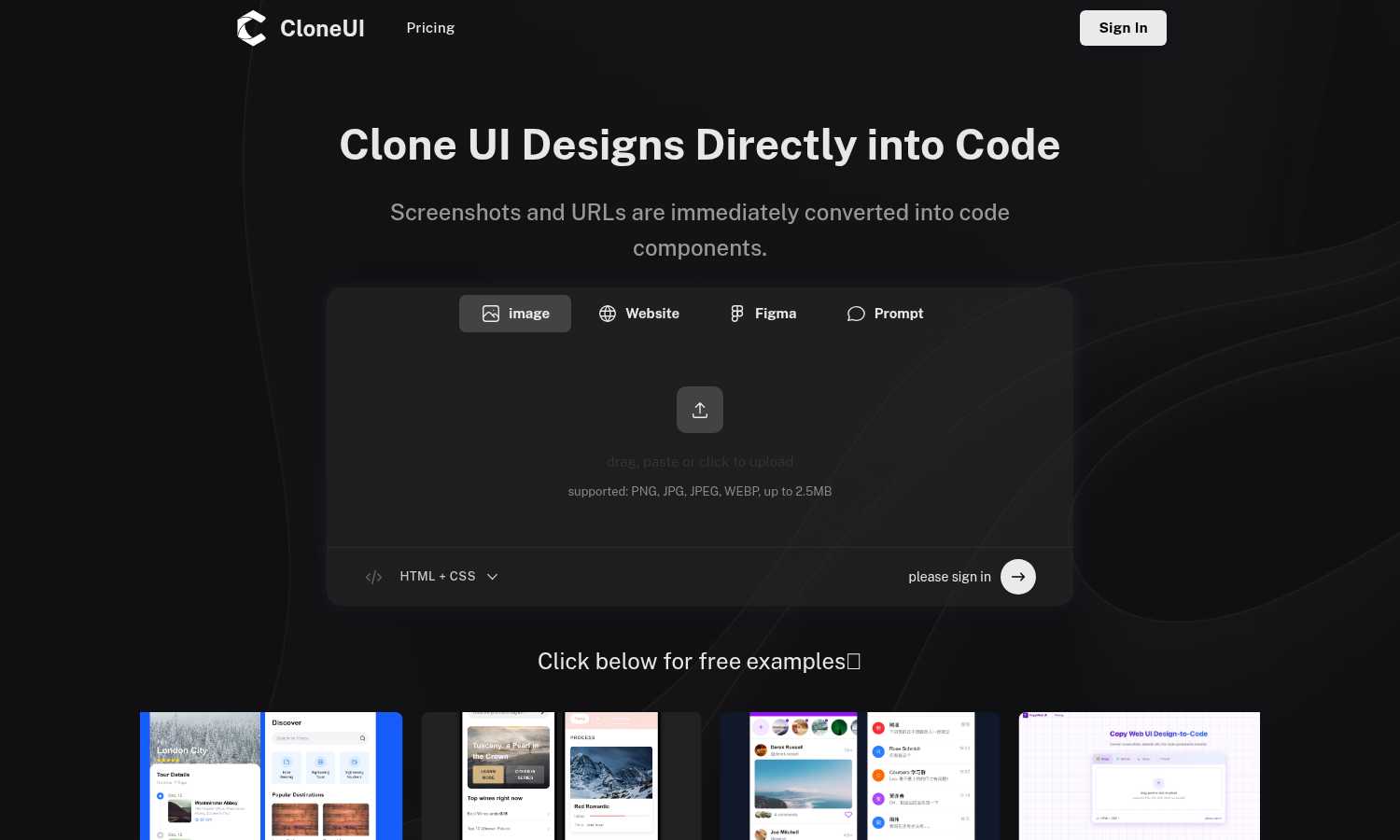
CloneUI enables your team to effortlessly transform designs into clean, responsive code from screenshots or URLs.
Last updated: March 1, 2026

Miget
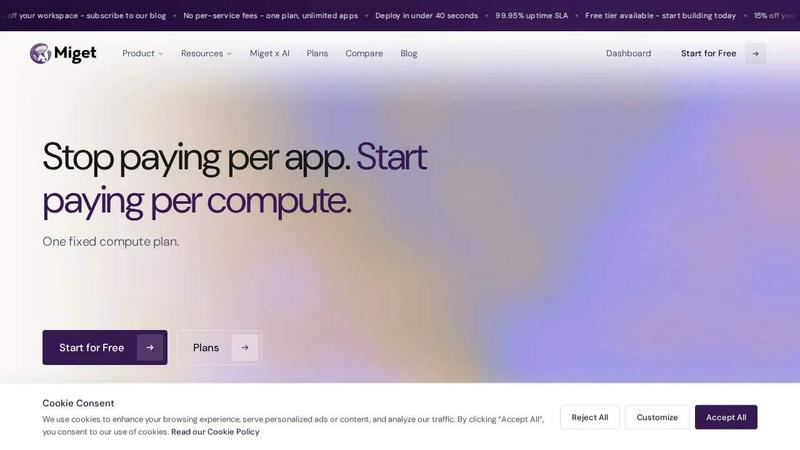
Miget lets your team deploy unlimited apps on one simple, flat-rate plan together.
Last updated: April 13, 2026
Visual Comparison
CloneUI
Miget
Feature Comparison
CloneUI
Convert Screenshots to Code
With CloneUI, uploading a design screenshot generates pixel-perfect code in seconds. This feature eliminates the guesswork involved in coding, ensuring that every pixel aligns with your original vision.
Clone from URL
This innovative functionality allows users to effortlessly replicate entire website structures by simply entering a URL. You can capture the essence of existing designs and use them as a foundation for your projects.
Figma to Code Conversion
One-click conversion from Figma to code simplifies the design-to-development handoff. Designers can easily translate their Figma designs into functional code, minimizing the back-and-forth communication often required.
Intelligent Component Recognition
CloneUI features AI-powered automatic UI component identification and mapping, ensuring that each element is recognized and translated accurately into code components. This enhances collaboration, as both designers and developers can trust the output.
Miget
Unlimited Services per Plan
Miget's core innovation is its billing model. Once you choose a compute plan, you can deploy as many applications, relational databases, key-value stores, and background workers as your resources can handle. This eliminates the fragmented, per-component pricing of traditional PaaS, creating a collaborative environment where adding a new microservice or a preview environment is a technical decision, not a financial one. Teams can architect freely, knowing their monthly bill remains fixed and predictable.
GitHub-Native Deployments & Preview Apps
Fostering seamless team collaboration, Miget integrates directly with your GitHub workflow. Every push to a branch can trigger an automatic build and deployment, with aggressive caching for sub-40-second deploy times. Crucially, every pull request automatically generates a full-stack preview environment—complete with its own URL, isolated database, and configuration. This allows entire teams, from developers to product managers, to review and test features in a production-like setting, enhancing cooperation and quality.
Managed Data Services Within Compute
Miget includes managed databases like PostgreSQL and Valkey (Redis-compatible) as integral parts of your compute plan, not as expensive add-ons. This means provisioning a new database for a feature branch or a new service does not incur extra fees. It simplifies the stack, reduces cost anxiety, and allows developers to use the right data tools for the job, all while maintaining the operational benefits of a fully managed service.
Full-Stack Cloning & Instant Redeploys
To accelerate team development and testing cycles, Miget allows you to clone an entire application, its database, and its data with a single click. This creates perfect replicas for debugging, testing, or onboarding. Coupled with intelligent buildpacks (Migetpacks) that auto-detect your stack and cache dependencies, this feature enables instant redeploys and environment duplication, ensuring team members can collaborate on identical setups without manual, error-prone configuration.
Use Cases
CloneUI
Rapid Prototyping
CloneUI is perfect for teams looking to rapidly prototype their ideas. By converting designs into code quickly, teams can iterate on functionality and user experience without the usual delays in the development process.
Freelance Development
Freelancers can significantly enhance their workflow by utilizing CloneUI. They can deliver high-quality work faster, allowing them to take on more clients and projects while maintaining the quality of their output.
Agency Projects
Agencies handling multiple projects can benefit from CloneUI's ability to streamline the design process. By generating code from designs, teams can focus on creative strategies rather than spending time on repetitive coding tasks.
Educational Purposes
For educators and students in design and development, CloneUI serves as a valuable learning tool. It provides insights into how designs are translated into code, making it easier to understand the intricacies of web development.
Miget
Indie Hackers & Solo Founders
For indie hackers launching a startup, Miget is the ideal partner. It provides a full PaaS experience—application hosting, database, and cache—under one predictable, fixed monthly bill. This eliminates budgeting uncertainty, allowing founders to focus their energy on product development and user feedback. The push-to-deploy from GitHub and per-PR preview apps enable rapid, professional iteration cycles typically reserved for larger teams.
Growing Product Teams
As a startup scales, its infrastructure needs to scale cooperatively with the team. Miget supports growing teams by providing autoscaling within the pre-paid compute allocation, team roles, audit logs, and support for custom domains with automatic SSL. This allows engineering teams to adopt a microservices architecture, spin up preview environments for every feature, and manage staging setups without the cost explosions that force difficult platforming conversations.
AI & Prototyping Projects
For developers and teams experimenting with AI-generated code or rapid prototyping, Miget's model is perfect. The ability to deploy from a prompt or a simple configuration file (like skills.md) without deep Git or terminal knowledge lowers the barrier to entry. Unlimited services within a plan encourage experimentation with different models, APIs, and backend services, and preview URLs make it easy to share working demos with collaborators or stakeholders instantly.
Enterprise Development & Compliance
For larger organizations, Miget offers the control and compliance needed for enterprise-grade development. It supports bringing your own cloud (BYOC) or bare metal, and provides tools like Helm charts and Terraform modules for custom orchestration. This allows enterprise platform teams to offer a simple, Heroku-like developer experience internally, while maintaining control over security, compliance, data residency, and costs, fostering synergy between platform engineers and application development teams.
Overview
About CloneUI
CloneUI is a groundbreaking AI-powered tool that transforms the way design and development teams collaborate, enabling a seamless workflow from concept to execution. It is tailored for designers and developers looking to enhance their productivity by eliminating the tedious process of converting visual designs into code. With CloneUI, users can instantly convert static screenshots, live website URLs, or Figma design files into clean, production-ready code components. The intelligent algorithms at the core of CloneUI analyze inputs, ensuring that generated code is precise and responsive across various devices. This tool not only accelerates the development process but also allows teams to focus on more complex tasks, fostering a cooperative environment that encourages innovation. By turning design inspirations into tangible code, CloneUI becomes an essential asset for agile teams, freelance developers, and agencies aiming to deliver high-quality projects at an accelerated pace.
About Miget
Miget is a modern, collaborative platform-as-a-service (PaaS) that fundamentally rethinks how teams pay for and manage their cloud infrastructure. It moves away from the traditional, costly model of charging per application, database, or worker. Instead, Miget operates on a simple, predictable principle: you select a fixed compute plan based on the resources you need, and then deploy an unlimited number of services—apps, databases, background workers, and preview environments—within that single allocation. This model is built for synergy, empowering developers, indie hackers, and engineering teams to experiment, iterate, and scale without the fear of spiraling, per-service billing surprises. Built on robust Kubernetes with full tenant isolation, Miget offers a production-ready experience from day one, featuring seamless Git integration, zero-config builds, managed data services like PostgreSQL and Redis, automatic TLS, and a 99.95% uptime SLA. It combines the affordability and control of a VPS with the legendary simplicity of platforms like Heroku, fostering a cooperative environment where infrastructure costs are predictable, and teams can focus purely on building what's next, together.
Frequently Asked Questions
CloneUI FAQ
Which input formats are compatible with CloneUI?
CloneUI supports various input formats, including PNG, JPG, JPEG, and WEBP images, allowing users to upload design screenshots with ease.
How is the code generated?
The code is generated through advanced AI algorithms that analyze the uploaded designs or URLs, ensuring that the output is clean, responsive, and ready for production.
Supported frameworks?
CloneUI offers flexibility by allowing users to export generated code to their preferred frameworks, including React, Vue, or plain HTML/CSS.
Is the generated code customizable?
Yes, the generated code can be customized to fit specific project needs, allowing developers to tweak the output while maintaining the integrity of the original design.
Miget FAQ
How is Miget different from traditional PaaS like Heroku?
Traditional PaaS platforms charge separately for each component: a web dyno, a worker dyno, a PostgreSQL add-on, a Redis add-on, etc. This per-service billing can become very expensive. Miget flips this model. You pay for a block of compute resources (CPU/RAM) in a fixed plan, and you can run an unlimited number of apps, databases, and workers inside that plan. This makes costs predictable and scales with your actual resource usage, not your service count.
What happens if I exceed my plan's compute resources?
Miget is designed for cooperative scaling within boundaries. Your applications can autoscale horizontally, but they will do so only within the total CPU and memory limits of your selected plan. If you consistently need more resources, you would upgrade to a larger compute plan. This model prevents surprise bills from unexpected traffic spikes while giving you clear control over your maximum monthly spend.
Are the managed databases (PostgreSQL, Redis) production-ready?
Yes, absolutely. The managed PostgreSQL, Valkey (Redis), and other data services are built with production workloads in mind. They run within your isolated compute environment, benefit from the platform's 99.95% uptime SLA, and include standard features like automated backups, point-in-time recovery, and high availability configurations. They are not "lite" versions; they are fully managed services included in your plan.
Can I use my own custom domain and SSL certificate?
Yes, Miget fully supports custom domains. You can easily connect your domain (e.g., app.yourcompany.com) to your Miget application through the dashboard or CLI. The platform automatically provisions and manages TLS/SSL certificates for you via Let's Encrypt, ensuring your applications are served over HTTPS with valid certificates that auto-renew, requiring zero ongoing configuration from your team.
Alternatives
CloneUI Alternatives
CloneUI is a groundbreaking AI-powered tool that sits at the intersection of design and development, enabling teams to transform visual designs into clean, production-ready code efficiently. As organizations strive for greater collaboration between designers and developers, users often seek alternatives to CloneUI due to factors like pricing, specific feature requirements, or compatibility with existing workflows. When selecting an alternative, it's essential to consider the range of design input formats supported, the intelligence of its component recognition capabilities, and how well it integrates with your team's current processes to ensure a seamless transition and continued productivity.
Miget Alternatives
Miget is a modern platform-as-a-service (PaaS) solution that simplifies deploying and managing applications, databases, and background workers. It operates within the low-code and no-code ecosystem, focusing on streamlining infrastructure so development teams can concentrate on building features rather than managing servers. Its core innovation is a flat-rate compute model, a significant shift from traditional per-service billing. Teams often explore alternatives to find the perfect fit for their unique workflow and budget. Common reasons include needing a different pricing structure, specific integrations, more granular control over the underlying infrastructure, or specialized features for complex use cases. The search is a natural part of selecting a platform that aligns with a team's technical requirements and financial planning. When evaluating options, consider your team's primary needs. Key factors include the predictability of costs, the ease of deployment and developer experience, the availability of managed data services, and the overall philosophy of the platform. The goal is to find a solution that fosters collaboration, reduces operational overhead, and allows your team to deploy with confidence and synergy.