OpenMark AI vs qtrl.ai
Side-by-side comparison to help you choose the right product.

OpenMark AI helps your team benchmark over 100 AI models on your specific task to find the best one for cost, speed, and quality.
Last updated: March 26, 2026

qtrl.ai
qtrl.ai helps QA teams scale testing with AI agents while maintaining full control and governance.
Last updated: March 4, 2026
Visual Comparison
OpenMark AI
qtrl.ai
Feature Comparison
OpenMark AI
Plain Language Task Description
Describe the specific task you need an AI model to perform using simple, natural language—no coding required. Whether it's data extraction, content classification, translation, or building a RAG pipeline, you can define your exact success criteria. The platform then translates this into structured prompts to ensure every model in your benchmark is tested against the same, relevant challenge, fostering a shared understanding across technical and non-technical team members.
Multi-Model Benchmarking in One Session
Run your defined task against a wide selection of models from leading providers like OpenAI, Anthropic, and Google in a single, unified session. This eliminates the tedious process of manually configuring separate API keys and writing individual test scripts for each model. Your team gets immediate, side-by-side comparisons, streamlining the evaluation process and enabling faster, consensus-driven decision-making.
Comprehensive Performance Metrics
Move beyond marketing claims with metrics derived from real API calls. Compare not just token cost, but the actual cost per request, latency, and a scored assessment of output quality for your task. Most importantly, OpenMark runs multiple iterations to measure stability and variance, showing you how consistent a model's performance is. This holistic view ensures your team chooses a model that is both cost-effective and reliably high-quality.
Hosted Credits System
Simplify collaboration and budgeting with a unified credits system. Team members can run benchmarks without needing to provision or share sensitive individual API keys from different vendors. This centralized approach makes it easy to manage testing costs, track usage across projects, and ensure everyone is working from the same financial and operational framework, enhancing team synergy.
qtrl.ai
Enterprise-Grade Test Management
qtrl provides a centralized, collaborative hub for all your testing activities. Your team can work together to organize test cases, plan comprehensive test runs, and maintain full traceability from requirements to coverage. This structured foundation, built with compliance and auditability in mind, gives everyone clear visibility into quality status, helping you manage risk as a unified group.
Progressive AI Automation
This feature allows your team to adopt automation at your own pace, working in synergy with AI. Start by writing high-level test instructions for the AI to execute. As trust builds, leverage qtrl to generate full test scripts from plain English, which your team can review and approve. The platform even suggests new tests based on coverage gaps, making automation a collaborative, step-by-step journey.
Autonomous QA Agents
qtrl's intelligent agents act as an extension of your team, executing test instructions on demand or continuously across multiple browsers and real environments. They operate within the rules and permissions your team sets, providing scalable execution power without hidden "black-box" decisions. This allows human testers to focus on complex scenarios while agents handle repetitive tasks.
Adaptive Memory & Multi-Environment Execution
The platform builds a living, shared knowledge base of your application by learning from every exploration, test run, and issue. This collective intelligence powers smarter, context-aware test generation that improves over time. Coupled with the ability to run tests seamlessly across development, staging, and production environments with secure secrets management, your team ensures consistent quality at every stage.
Use Cases
OpenMark AI
Validating Model Choice Before Development
Development teams can collaboratively test multiple LLMs on a prototype task before committing engineering resources. This ensures the selected model fits the technical requirements and budget constraints, preventing costly rework later and aligning the entire team on a proven, data-backed foundation for the upcoming build phase.
Optimizing Cost-Efficiency for Production Features
Product and engineering leads can work together to find the most cost-effective model for a live feature without sacrificing quality. By benchmarking on real user prompts, teams can identify if a smaller, less expensive model performs just as well as a premium one for their specific use case, directly improving the feature's ROI through cooperative analysis.
Ensuring Output Consistency and Reliability
Teams building features where consistent outputs are critical—such as data extraction pipelines or automated customer support—can use OpenMark to stress-test models. By analyzing variance across multiple runs, the team can collaboratively identify and select a model that delivers stable, predictable results, building trust in the AI component's performance.
Comparing New Model Releases
When a new model version is released, teams can quickly benchmark it against their currently used model on their exact tasks. This facilitates a streamlined, evidence-based upgrade discussion, allowing the team to collaboratively assess if the new model offers meaningful improvements in quality, speed, or cost for their application.
qtrl.ai
Scaling Beyond Manual Testing
For QA teams overwhelmed by repetitive manual checks, qtrl offers a cooperative path forward. Teams can begin by structuring their existing manual cases in the platform, then gradually introduce AI agents to automate the most time-consuming scripts. This collaborative approach allows testers to upskill and focus on high-value exploratory testing while confidently scaling coverage.
Modernizing Legacy QA Workflows
Companies stuck with outdated, siloed, or script-heavy automation frameworks can use qtrl to modernize cohesively. The platform integrates with existing tools and CI/CD pipelines, allowing teams to incrementally replace brittle scripts with AI-maintained tests. This fosters a smoother transition, bringing development and QA together on a single, transparent platform.
Governing Enterprise AI Testing
Enterprises requiring strict compliance, audit trails, and governance can safely leverage AI with qtrl. The platform's permissioned autonomy levels, full agent visibility, and enterprise-ready security ensure that AI automation enhances control rather than undermining it. Teams can demonstrate clear traceability from requirement to test execution for every release.
Empowering Product-Led Engineering Teams
Product-led engineering teams that prize velocity and ownership can embed quality into their workflow with qtrl. Developers and product managers can write simple English instructions for features, and qtrl's agents can generate and run the corresponding tests, creating a synergistic feedback loop that catches issues early without creating a testing bottleneck.
Overview
About OpenMark AI
OpenMark AI is a collaborative web platform designed to empower development and product teams to make data-driven decisions when integrating AI. It eliminates the guesswork from selecting the right large language model (LLM) for a specific feature or workflow. The core value proposition is enabling teams to benchmark models side-by-side on their exact tasks using plain language, without the need for complex setup or managing multiple API keys. By running the same prompts against a vast catalog of over 100 models in a single session, teams can compare critical real-world metrics like cost per request, latency, scored output quality, and—crucially—output stability across repeat runs. This focus on consistency reveals performance variance, ensuring you select a reliable model, not just one that got lucky once. OpenMark AI is built for pre-deployment validation, helping teams collaboratively find the optimal balance of cost-efficiency and quality for their unique application before any code is shipped.
About qtrl.ai
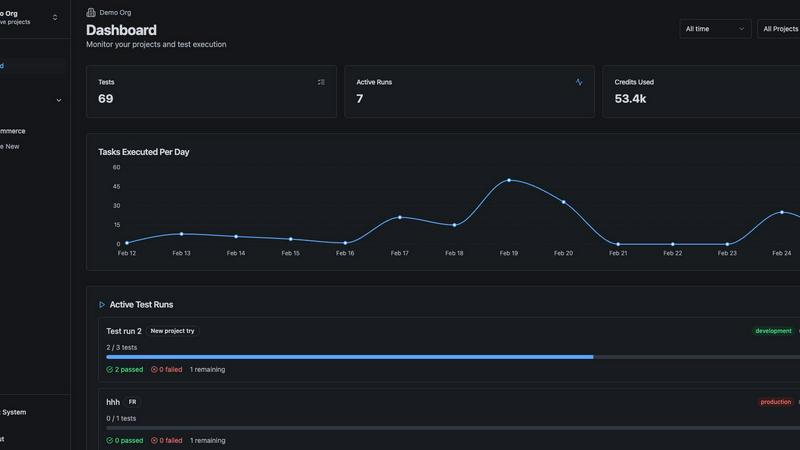
qtrl.ai is a modern, collaborative QA platform designed to help software teams scale their quality assurance efforts together, without ever sacrificing control or governance. It uniquely bridges the gap between structured test management and powerful, trustworthy AI automation, creating a synergistic hub for your entire quality process. At its core, qtrl provides a centralized workspace where teams can collaboratively organize test cases, plan test runs, trace requirements to coverage, and track quality metrics through shared, real-time dashboards. This foundation ensures clear, unified visibility into what's been tested and where potential risks lie, fostering better alignment between engineering leads, QA managers, and developers.
Where qtrl truly empowers teams is through its progressive AI layer. Instead of imposing a risky, fully autonomous "black-box" approach, qtrl introduces intelligent automation gradually and cooperatively. Teams can start with simple manual test management and, when ready, leverage built-in autonomous agents as trusted partners. These agents work alongside your team, generating UI tests from plain English descriptions, maintaining them as the application evolves, and executing them at scale. This makes qtrl the perfect collaborative partner for product-led engineering teams, QA groups moving beyond manual testing, companies modernizing legacy workflows, and enterprises that require strict compliance and audit trails. Ultimately, qtrl's mission is to help your team bridge the gap between the slow pace of manual testing and the brittle complexity of traditional automation, offering a trusted, cooperative path to faster, more intelligent quality assurance.
Frequently Asked Questions
OpenMark AI FAQ
How does OpenMark AI calculate the quality score?
The quality score is determined by evaluating the model's outputs against the specific task you defined. While the exact scoring methodology is tailored to the task type, it generally involves automated checks for accuracy, completeness, and adherence to your instructions. This objective scoring helps teams move beyond subjective opinions to a shared, quantitative understanding of model performance.
Do I need my own API keys to use OpenMark AI?
No, you do not need to configure or manage separate API keys from providers like OpenAI or Anthropic. OpenMark operates on a hosted credits system. You purchase credits through the platform and use them to run benchmarks, which are executed via OpenMark's own integrations. This simplifies setup and secures your team's workflow.
What is the benefit of testing for stability/variance?
Testing stability by running the same prompt multiple times shows you whether a model's good output was a lucky one-off or a reliable result. High variance means the model is inconsistent, which is a major risk for production features. This insight allows your team to choose a predictably good performer, ensuring a better user experience and reducing operational headaches.
Can I use OpenMark for tasks beyond simple text generation?
Absolutely. OpenMark is designed for a wide variety of task-level benchmarking, including complex workflows like classification, translation, data extraction, question answering, RAG (Retrieval-Augmented Generation) systems, and even image analysis with multimodal models. Describe your collaborative project's needs, and you can benchmark models suited for that specific challenge.
qtrl.ai FAQ
How does qtrl.ai ensure we don't lose control with AI?
qtrl is built on a philosophy of "permissioned autonomy." Your team always sets the rules. You start with simple, human-written instructions that the AI executes exactly. As you progress, every AI-generated test is fully reviewable and requires approval before being added to your suite. You maintain full visibility into all agent activities and decide what automates and what scales.
Can qtrl.ai integrate with our existing development tools?
Yes, qtrl is designed for real-world, collaborative workflows. It offers built-in support for requirements management tools and seamless CI/CD pipeline integration. The platform is built to work alongside your existing stack, providing continuous quality feedback loops without forcing your team into a completely new ecosystem.
What makes qtrl's AI different from other "autonomous" testing tools?
Unlike black-box AI solutions that make unpredictable changes, qtrl's AI is progressive and transparent. It doesn't force an AI-first approach. Instead, it earns trust by working alongside your team, suggesting changes for review, and learning from your application's specific context. The focus is on cooperative augmentation, not full replacement.
Is qtrl.ai suitable for teams with strict security and compliance needs?
Absolutely. qtrl is built with enterprise-grade security and governance by design. Features like encrypted secrets management (where secrets are never exposed to the AI), full audit trails, permission controls, and data processing agreements make it suitable for regulated industries. Your team can leverage powerful automation while maintaining the necessary compliance posture.
Alternatives
OpenMark AI Alternatives
OpenMark AI is a developer tool for task-level benchmarking of large language models. It helps teams compare cost, speed, quality, and stability across 100+ LLMs in a single browser-based session, using real API calls to inform pre-deployment decisions. Teams often explore alternatives for various reasons, such as different budget constraints, a need for on-premise deployment, or requirements for more specialized testing features like automated regression or deeper performance analytics. The ideal tool varies based on a project's specific phase and technical needs. When evaluating other solutions, consider the scope of model coverage, the transparency of cost calculations, the depth of quality assessment metrics, and whether the platform provides genuine, uncached performance data. The goal is to find a benchmarking partner that offers clear, actionable insights tailored to your team's workflow and collaboration style.
qtrl.ai Alternatives
qtrl.ai is a modern QA platform in the automation and dev tools category, designed to help teams scale their testing efforts. It uniquely combines structured test management with trustworthy AI agents, allowing teams to automate tests while maintaining full control and governance over the process. Teams often explore alternatives for various reasons, such as budget constraints, specific feature requirements, or the need to integrate with a different development ecosystem. It's a natural part of finding the right collaborative fit for your team's unique workflow and goals. When evaluating options, consider how a solution balances intelligent automation with team oversight. Look for a platform that fosters synergy between manual and automated testing, provides clear visibility into quality metrics, and can adapt as your testing maturity grows. The right tool should feel like a seamless extension of your team's effort.