
LLMWise vs Nani
Side-by-side comparison to help you choose the right product.

LLMWise
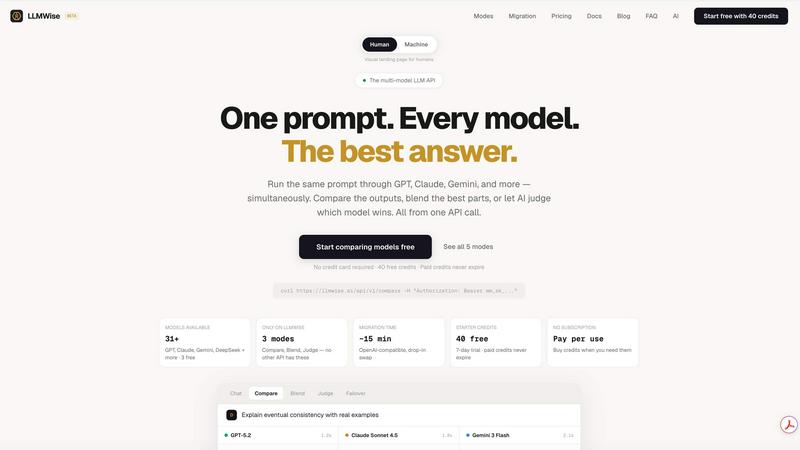
Unify your team's AI tools with one smart API that automatically picks the best model for every task.
Last updated: February 28, 2026

Nani
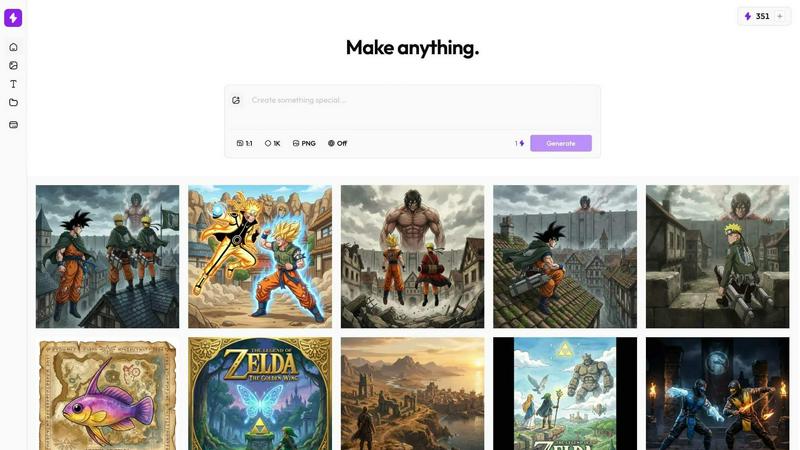
Nani organizes your team's AI image prompts and creations for a seamless, collaborative workflow.
Last updated: February 28, 2026
Visual Comparison
LLMWise
Nani
Feature Comparison
LLMWise
Intelligent Model Routing
LLMWise's smart routing acts as your AI conductor, analyzing each prompt and automatically directing it to the most suitable model from its vast catalog. This means code generation tasks are sent to the best coding model, creative briefs to the most eloquent writer, and analytical questions to the most logical reasoner. This feature removes the guesswork and manual switching between different provider dashboards, allowing your team to focus on building great products instead of managing AI infrastructure.
Compare, Blend, and Judge Modes
This suite of orchestration tools empowers teams to harness the collective intelligence of multiple models. Compare mode runs a single prompt across several models simultaneously, presenting their answers side-by-side with metrics on speed, cost, and length for easy evaluation. Blend mode takes this further by synthesizing the best parts of each model's output into one superior, cohesive answer. Judge mode enables models to critique and evaluate each other's responses, providing an automated layer of quality assurance.
Resilient Circuit-Breaker Failover
LLMWise ensures your application's AI capabilities never break. It includes an intelligent circuit-breaker system that monitors all connected providers in real-time. If a primary model or provider experiences high latency or an outage, traffic is instantly and automatically rerouted to a predefined backup model. This built-in redundancy guarantees high availability and reliability for production applications, giving your team and your users uninterrupted service.
Advanced Testing & Optimization Suite
Teams can systematically improve their AI implementations with LLMWise's built-in testing tools. Create benchmark suites and run batch tests across models to measure performance on your specific prompts. Set optimization policies that automatically prioritize speed, cost, or accuracy for different types of requests. Automated regression checks help ensure that updates to models or prompts don't degrade the quality of your outputs, fostering a culture of continuous improvement and stable deployments.
Nani
Nano Banana Pro Engine
At the heart of Nani is the powerful Nano Banana Pro (Gemini) AI, providing a robust foundation for your creative work. This cutting-edge technology enables you to generate stunning, high-resolution images in seconds with a simple prompt. The interface is designed for immediate productivity, offering customizable aspect ratios and resolutions without any visible watermarks, ensuring your final assets are ready for professional use from the very first generation.
Reusable Prompt Sets
This feature is the cornerstone of collaborative efficiency. Teams can save and name specific prompt combinations as reusable "Sets." This allows everyone—from illustrators to social media managers—to maintain perfect consistency in characters, art styles, color palettes, and project themes across countless generations. It eliminates prompt guesswork and miscommunication, creating a single source of truth for your project's visual language that the entire team can leverage.
Organized Creative Library
Nani provides powerful organizational tools that scale with your team's output. Create shared folders for different projects, clients, or campaigns. Filter your growing library to quickly find favorited images, and use bulk-select actions for efficient management. This keeps the team's collective work tidy, accessible, and manageable, turning a chaotic feed of images into a well-structured, collaborative asset library.
Seamless Collaborative Workflow
Nani is built for teamwork. You can drag and drop any image as a visual reference for new generations, bridging ideas visually. Share any creation instantly with a public link for feedback or presentation. Most powerfully, you can let teammates recreate and build upon your work within their own accounts, enabling a true iterative and synergistic creative process where ideas evolve collectively.
Use Cases
LLMWise
Development and Prototyping
Developers can rapidly prototype AI features using the 30 permanently free models available at zero cost. This allows teams to experiment with different model capabilities, test prompt effectiveness, and build proof-of-concepts without any financial commitment. The compare mode is invaluable for debugging prompt issues by instantly seeing how different models interpret the same instruction, saving hours of trial and error.
Production Application Resilience
For teams running customer-facing AI applications, LLMWise's failover routing is critical. It ensures that if a primary AI service like GPT-4 has an outage, user requests are seamlessly handled by a backup model like Claude or Gemini, preventing downtime and maintaining a positive user experience. This turns a potential crisis into a minor, automated blip that your operations team doesn't need to manually manage.
Cost-Optimized AI Operations
Companies with existing API credits from major providers can use LLMWise's BYOK (Bring Your Own Keys) feature to plug in their keys and immediately benefit from smart routing and failover without changing their billing setup. This synergy between existing investments and new orchestration capabilities can lead to significant cost reductions, often over 40%, by ensuring the most cost-effective model is used for each task.
Content Creation and Evaluation
Marketing and content teams can use the blend and judge modes to produce higher-quality drafts. A single request can generate variations from multiple creative models, then synthesize the strongest elements into a final piece. Judge mode can then provide automated feedback on tone, clarity, and alignment with brand guidelines, creating a collaborative workflow between human creativity and AI assistance.
Nani
Consistent Brand Asset Creation
Marketing and design teams can use Nani to generate a large volume of on-brand imagery for campaigns, social media, and websites. By creating a "Set" with prompts defining the brand's color scheme, style, and mood, every team member can produce visuals that are cohesive and aligned, ensuring brand integrity across all generated assets without constant supervision or style guides.
Collaborative Storyboarding & Concept Art
Creative studios and game developers can streamline their pre-production phases. Artists can establish "Sets" for key characters, environments, and props. The team can then rapidly iterate on scenes, using the folder system to organize concepts by sequence or chapter, and drag-and-drop references to refine ideas together, accelerating the collaborative visioning process.
Efficient Content Production Pipelines
Content creators, bloggers, and agencies managing multiple clients can use Nani to maintain separate workflows for each project. By creating dedicated folders and prompt sets for each client or content theme, they can swiftly generate tailored illustrations and graphics, bulk-manage outputs, and maintain an organized library that makes asset retrieval and reporting simple and efficient.
Educational & Team Training Projects
Educators and trainers developing course materials or internal documentation can collaborate on creating custom imagery. A team can build a shared library of diagrams, historical recreations, or concept illustrations. The ability to share public links and recreate sets allows for easy distribution of visual resources and empowers others to generate complementary images for a unified learning experience.
Overview
About LLMWise
LLMWise is the ultimate orchestration platform for developers and teams building with large language models. It eliminates the complexity of managing multiple AI providers by offering a single, unified API to access over 62 models from 20 leading providers, including OpenAI, Anthropic, Google, Meta, xAI, and DeepSeek. The core value proposition is intelligent, task-based routing: you send a prompt, and LLMWise automatically selects the optimal model for the job, whether it's coding with GPT, creative writing with Claude, or translation with Gemini. This collaborative approach ensures you always get the best possible output without vendor lock-in.
Built for developers who demand performance and reliability, LLMWise goes beyond simple routing with powerful orchestration modes like side-by-side comparison, output blending, and model-judged evaluations. It ensures your applications are always resilient with automatic failover routing if a provider experiences downtime. With a flexible, credit-based pricing model and the option to bring your own API keys (BYOK), teams can significantly reduce costs while gaining unparalleled flexibility. Start with 20 free credits and access 30 permanently free models to prototype, test, and build with zero commitment.
About Nani
Nani is a collaborative workflow platform designed to transform AI image generation from a solitary, repetitive task into a streamlined, team-oriented creative process. Built for artists, designers, content creators, and creative teams, Nani addresses the core inefficiencies of standard AI art tools. It moves beyond one-off image creation to provide a structured environment where teams can build, iterate, and organize their visual projects together. Powered by Google's advanced Nano Banana Pro (Gemini) model, Nani delivers high-quality, watermark-free images. Its true value lies in fostering synergy: by allowing users to save reusable prompt sets, organize assets into shared folders, and seamlessly reference past work, Nani ensures that creative vision remains consistent and collaborative momentum is never lost. It’s the tool that lets your team focus on collective creativity, not administrative busywork, making it an indispensable hub for any project requiring regular, high-volume image generation.
Frequently Asked Questions
LLMWise FAQ
How does the pricing work?
LLMWise uses a simple, pay-as-you-go credit system with no monthly subscriptions. You start with 20 free trial credits that never expire. After that, you purchase credit packs. You are only charged credits when you use a paid model; the 30 free models always cost 0 credits. You also have the option to use your own existing API keys from providers (BYOK), in which case you pay the provider directly at their rates and only use LLMWise credits for the orchestration features.
What are the free models for?
The 30+ free models serve multiple strategic purposes. They are perfect for initial prototyping and development, allowing you to build and test without cost. They act as a smart fallback layer for non-critical traffic or during retries if paid models fail. They are also essential for benchmarking, enabling you to compare the quality and performance of free versus paid models on your specific tasks before deciding where to route production traffic.
How quickly can I integrate LLMWise?
You can be up and running in under two minutes. The process involves signing up for an account to receive your free credits, generating a single API key from your dashboard, and then making your first request using the provided Python/TypeScript SDKs or cURL examples. This unified API approach means you replace multiple provider-specific integrations with one simple connection.
What happens if a model provider is down?
LLMWise's circuit-breaker failover system handles this automatically. The platform continuously monitors the health and latency of all connected model providers. If a primary model becomes unavailable or too slow, the system instantly reroutes your application's requests to a pre-configured backup model from a different provider. This ensures your application's AI features remain operational without any manual intervention required from your team.
Nani FAQ
How do I start using Nani?
Getting started is simple and commitment-free. Just sign up for an account to instantly receive 5 free credits. There's no credit card required upfront. You can immediately explore the interface, generate your first images, and experience the collaborative features like creating Sets and folders to understand how Nani can streamline your team's workflow.
What is Nani's pricing model?
Nani uses a simple, transparent credit-based system. You only pay for the images you generate, with no monthly subscriptions or commitments. High-quality generations cost approximately 30 cents each. You purchase credits as needed, and they never expire. This flexible model ensures teams of any size can collaborate efficiently without being locked into a fixed fee, paying only for their actual production output.
Can I work with my team on the same projects?
Absolutely. Collaboration is central to Nani's design. While each user has their own account, you can easily share your work. You can send public links to any image for instant feedback and, most powerfully, others can use your shared prompt Sets to recreate and build upon your work within their own accounts, enabling a seamless back-and-forth creative process.
What makes Nani different from other AI image generators?
Unlike tools built for one-off creations, Nani is a comprehensive workflow platform designed for sustained, collaborative production. Its unique combination of reusable Prompt Sets, shared folder organization, and team-friendly features like reference dragging and public links addresses the real-world needs of teams who generate images regularly. It reduces repetitive tasks and misalignment, letting your team focus on synergy and creativity.
Alternatives
LLMWise Alternatives
LLMWise is a unified API platform in the AI assistants category, designed to give developers a single access point to leading large language models like GPT, Claude, and Gemini. Its core innovation is intelligent auto-routing, which automatically selects the best-suited model for each specific prompt to optimize performance. Users often explore alternatives for various reasons, such as different pricing structures, the need for specific platform integrations, or a desire for a different set of management and testing features. Some teams may prioritize a different balance between cost, control, and convenience. When evaluating other solutions, it's wise to consider your team's primary needs. Key factors include the flexibility of the API, the depth of analytics and testing tools, the robustness of failover systems, and the overall pricing model. The goal is to find a tool that enhances your team's collaborative workflow without adding unnecessary complexity.
Nani Alternatives
Nani is a specialized AI workflow tool within the broader AI Assistants category, designed to organize prompts and images into reusable sets. It transforms the often chaotic process of AI image generation into a structured and repeatable creative system. Users may explore alternatives for various reasons, such as budget constraints, the need for different core AI models, or specific platform integrations. Some may seek tools with a different focus, like advanced in-painting or 3D generation, rather than Nani's strength in workflow management and consistency. When evaluating other options, consider your primary need: is it raw image quality, cost, collaboration features, or, like Nani, streamlining a repetitive creative process? The best fit aligns with your workflow requirements, team size, and how much you value organized prompt libraries versus one-off generation.