Mechasm.ai vs qtrl.ai
Side-by-side comparison to help you choose the right product.

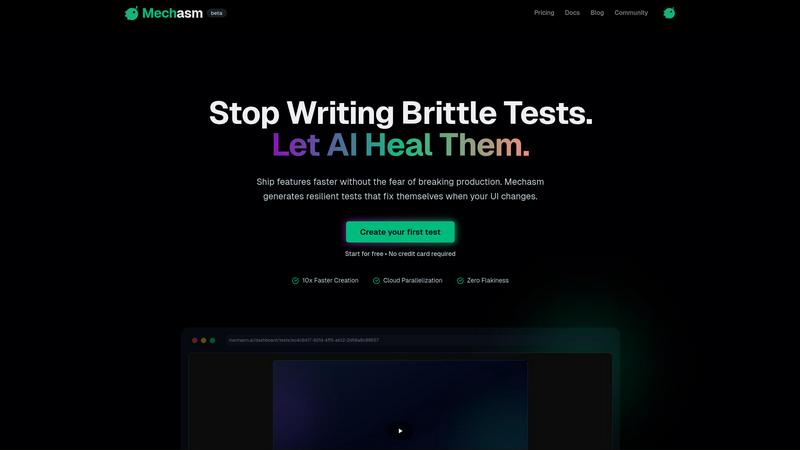
Mechasm.ai empowers teams to effortlessly create self-healing tests in plain English, ensuring reliable and faster.
Last updated: February 28, 2026

qtrl.ai
qtrl.ai helps QA teams scale testing with AI agents while maintaining full control and governance.
Last updated: March 4, 2026
Visual Comparison
Mechasm.ai
qtrl.ai
Feature Comparison
Mechasm.ai
Self-Healing Tests
Mechasm.ai features self-healing tests that automatically adapt to changes in the user interface (UI). When UI elements change, the AI identifies the alterations and updates the selectors without manual input, reducing maintenance efforts by up to 90%. This ensures that tests remain relevant and functional despite ongoing development.
Natural Language Testing
With Mechasm.ai, writing tests becomes as simple as typing in plain English. Users can describe their testing scenarios in everyday language, and the AI translates these descriptions into robust automation code. This feature democratizes testing by allowing non-technical team members to contribute meaningfully to quality assurance.
Cloud Parallelization
The platform supports cloud parallelization, enabling teams to scale their testing efforts effortlessly. This feature allows users to run hundreds of tests simultaneously in a secure cloud environment, significantly speeding up the QA process and facilitating faster deployments. The infrastructure is designed to handle extensive testing without any setup required.
Comprehensive Analytics
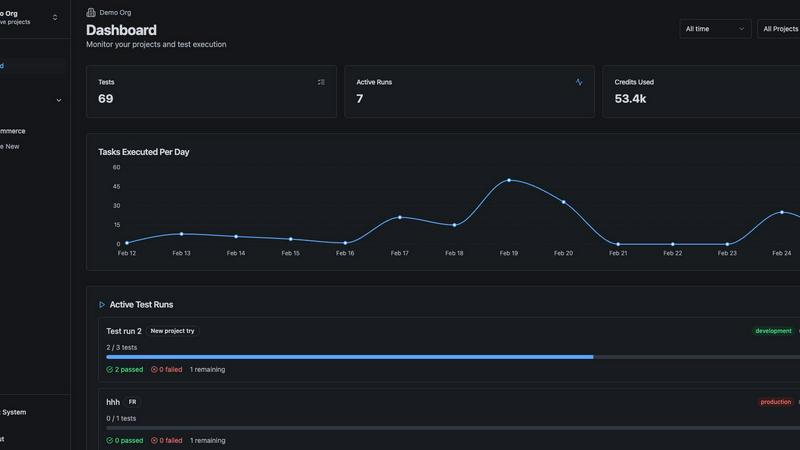
Mechasm.ai includes actionable analytics that provide insights into test performance and team health. Users can access health scores, trend analysis, and performance tracking, allowing them to monitor the effectiveness of their testing strategies and make data-driven decisions to enhance their QA processes.
qtrl.ai
Enterprise-Grade Test Management
qtrl provides a centralized, collaborative hub for all your testing activities. Your team can work together to organize test cases, plan comprehensive test runs, and maintain full traceability from requirements to coverage. This structured foundation, built with compliance and auditability in mind, gives everyone clear visibility into quality status, helping you manage risk as a unified group.
Progressive AI Automation
This feature allows your team to adopt automation at your own pace, working in synergy with AI. Start by writing high-level test instructions for the AI to execute. As trust builds, leverage qtrl to generate full test scripts from plain English, which your team can review and approve. The platform even suggests new tests based on coverage gaps, making automation a collaborative, step-by-step journey.
Autonomous QA Agents
qtrl's intelligent agents act as an extension of your team, executing test instructions on demand or continuously across multiple browsers and real environments. They operate within the rules and permissions your team sets, providing scalable execution power without hidden "black-box" decisions. This allows human testers to focus on complex scenarios while agents handle repetitive tasks.
Adaptive Memory & Multi-Environment Execution
The platform builds a living, shared knowledge base of your application by learning from every exploration, test run, and issue. This collective intelligence powers smarter, context-aware test generation that improves over time. Coupled with the ability to run tests seamlessly across development, staging, and production environments with secure secrets management, your team ensures consistent quality at every stage.
Use Cases
Mechasm.ai
Rapid Feature Testing
Teams can utilize Mechasm.ai to quickly create and execute tests for new features. By describing functionalities in plain English, they can generate tests almost instantly, allowing for rapid iterations and quicker feature releases without compromising on quality.
Collaborating Across Teams
Mechasm.ai fosters collaboration among diverse roles within engineering teams. Product managers, designers, and developers can all contribute to the QA process by writing tests in natural language, ensuring that all perspectives are considered in the testing phase.
Reducing Maintenance Overhead
By implementing self-healing tests, organizations can significantly reduce the time and resources spent on test maintenance. The AI automatically adjusts tests to accommodate UI changes, allowing QA teams to focus on higher-level tasks instead of manual updates.
Integrating with CI/CD Pipelines
Mechasm.ai seamlessly integrates with existing continuous integration and continuous deployment (CI/CD) workflows. This compatibility enables teams to receive immediate feedback on their code changes, enhancing deployment confidence and ensuring that quality assurance remains a priority throughout the development lifecycle.
qtrl.ai
Scaling Beyond Manual Testing
For QA teams overwhelmed by repetitive manual checks, qtrl offers a cooperative path forward. Teams can begin by structuring their existing manual cases in the platform, then gradually introduce AI agents to automate the most time-consuming scripts. This collaborative approach allows testers to upskill and focus on high-value exploratory testing while confidently scaling coverage.
Modernizing Legacy QA Workflows
Companies stuck with outdated, siloed, or script-heavy automation frameworks can use qtrl to modernize cohesively. The platform integrates with existing tools and CI/CD pipelines, allowing teams to incrementally replace brittle scripts with AI-maintained tests. This fosters a smoother transition, bringing development and QA together on a single, transparent platform.
Governing Enterprise AI Testing
Enterprises requiring strict compliance, audit trails, and governance can safely leverage AI with qtrl. The platform's permissioned autonomy levels, full agent visibility, and enterprise-ready security ensure that AI automation enhances control rather than undermining it. Teams can demonstrate clear traceability from requirement to test execution for every release.
Empowering Product-Led Engineering Teams
Product-led engineering teams that prize velocity and ownership can embed quality into their workflow with qtrl. Developers and product managers can write simple English instructions for features, and qtrl's agents can generate and run the corresponding tests, creating a synergistic feedback loop that catches issues early without creating a testing bottleneck.
Overview
About Mechasm.ai
Mechasm.ai is an innovative automated testing platform designed specifically for modern engineering teams that face the challenges of traditional quality assurance (QA) methods. As software development evolves, legacy testing frameworks often impede progress, making it essential for teams to adopt more agile solutions. Mechasm.ai introduces a groundbreaking approach known as Agentic QA, allowing users to write tests in plain English. This user-friendly accessibility empowers not just QA engineers but also developers, product managers, and designers to collaborate effectively in enhancing the quality assurance process. The platform's primary value proposition lies in its ability to generate resilient, self-healing tests that automatically adapt to UI changes without requiring manual intervention. By bridging the gap between human intent and technical execution, Mechasm.ai facilitates faster feature delivery and instills greater confidence in production deployments. This ultimately leads to enhanced team synergy and operational efficiency, ensuring that teams can ship high-quality code without the fear of breaking existing functionalities.
About qtrl.ai
qtrl.ai is a modern, collaborative QA platform designed to help software teams scale their quality assurance efforts together, without ever sacrificing control or governance. It uniquely bridges the gap between structured test management and powerful, trustworthy AI automation, creating a synergistic hub for your entire quality process. At its core, qtrl provides a centralized workspace where teams can collaboratively organize test cases, plan test runs, trace requirements to coverage, and track quality metrics through shared, real-time dashboards. This foundation ensures clear, unified visibility into what's been tested and where potential risks lie, fostering better alignment between engineering leads, QA managers, and developers.
Where qtrl truly empowers teams is through its progressive AI layer. Instead of imposing a risky, fully autonomous "black-box" approach, qtrl introduces intelligent automation gradually and cooperatively. Teams can start with simple manual test management and, when ready, leverage built-in autonomous agents as trusted partners. These agents work alongside your team, generating UI tests from plain English descriptions, maintaining them as the application evolves, and executing them at scale. This makes qtrl the perfect collaborative partner for product-led engineering teams, QA groups moving beyond manual testing, companies modernizing legacy workflows, and enterprises that require strict compliance and audit trails. Ultimately, qtrl's mission is to help your team bridge the gap between the slow pace of manual testing and the brittle complexity of traditional automation, offering a trusted, cooperative path to faster, more intelligent quality assurance.
Frequently Asked Questions
Mechasm.ai FAQ
How does Mechasm.ai ensure test resilience?
Mechasm.ai employs self-healing technology that automatically adjusts to UI changes. When a test fails due to a UI alteration, the AI attempts to fix the selectors and adapt the test, ensuring minimal disruption and maintaining test reliability.
Can non-technical team members write tests in Mechasm.ai?
Absolutely. One of the key features of Mechasm.ai is its natural language testing capability, allowing anyone on the team—regardless of technical expertise—to write tests in plain English, thus promoting collaboration across various roles.
What type of analytics does Mechasm.ai provide?
Mechasm.ai offers comprehensive analytics, including health scores, trend analysis, and performance tracking. These insights help teams monitor their testing effectiveness and make informed decisions to optimize their QA processes.
Is Mechasm.ai compatible with existing CI/CD tools?
Yes, Mechasm.ai integrates seamlessly with popular CI/CD tools like GitHub Actions, GitLab, and Slack. This integration allows teams to incorporate testing into their workflows without additional setup, streamlining the deployment process and enhancing overall efficiency.
qtrl.ai FAQ
How does qtrl.ai ensure we don't lose control with AI?
qtrl is built on a philosophy of "permissioned autonomy." Your team always sets the rules. You start with simple, human-written instructions that the AI executes exactly. As you progress, every AI-generated test is fully reviewable and requires approval before being added to your suite. You maintain full visibility into all agent activities and decide what automates and what scales.
Can qtrl.ai integrate with our existing development tools?
Yes, qtrl is designed for real-world, collaborative workflows. It offers built-in support for requirements management tools and seamless CI/CD pipeline integration. The platform is built to work alongside your existing stack, providing continuous quality feedback loops without forcing your team into a completely new ecosystem.
What makes qtrl's AI different from other "autonomous" testing tools?
Unlike black-box AI solutions that make unpredictable changes, qtrl's AI is progressive and transparent. It doesn't force an AI-first approach. Instead, it earns trust by working alongside your team, suggesting changes for review, and learning from your application's specific context. The focus is on cooperative augmentation, not full replacement.
Is qtrl.ai suitable for teams with strict security and compliance needs?
Absolutely. qtrl is built with enterprise-grade security and governance by design. Features like encrypted secrets management (where secrets are never exposed to the AI), full audit trails, permission controls, and data processing agreements make it suitable for regulated industries. Your team can leverage powerful automation while maintaining the necessary compliance posture.
Alternatives
Mechasm.ai Alternatives
Mechasm.ai is an advanced automated testing platform designed to empower modern engineering teams through its innovative approach to quality assurance. It belongs to the categories of AI Assistants, No Code & Low Code tools, and Tech Tools, facilitating collaboration among QA engineers, developers, product managers, and designers. Users often seek alternatives to Mechasm.ai for various reasons, including pricing structures, feature sets, or specific platform requirements that better align with their team's needs. When choosing an alternative to Mechasm.ai, it’s essential to consider several factors. Look for platforms that offer natural language authoring capabilities, self-healing tests, and seamless execution environments. Additionally, evaluate how well the alternative can integrate with your existing workflows and whether it fosters collaboration across different team members in the testing process.
qtrl.ai Alternatives
qtrl.ai is a modern QA platform in the automation and dev tools category, designed to help teams scale their testing efforts. It uniquely combines structured test management with trustworthy AI agents, allowing teams to automate tests while maintaining full control and governance over the process. Teams often explore alternatives for various reasons, such as budget constraints, specific feature requirements, or the need to integrate with a different development ecosystem. It's a natural part of finding the right collaborative fit for your team's unique workflow and goals. When evaluating options, consider how a solution balances intelligent automation with team oversight. Look for a platform that fosters synergy between manual and automated testing, provides clear visibility into quality metrics, and can adapt as your testing maturity grows. The right tool should feel like a seamless extension of your team's effort.