Image to 3D AI vs LLMWise
Side-by-side comparison to help you choose the right product.

Image to 3D AI
Transform your images into 3D models instantly with our free, collaborative AI tool.
Last updated: March 1, 2026

Unify your team's AI tools with one smart API that automatically picks the best model for every task.
Last updated: February 28, 2026
Visual Comparison
Image to 3D AI
LLMWise
Feature Comparison
Image to 3D AI
AI-Powered Textured Conversion
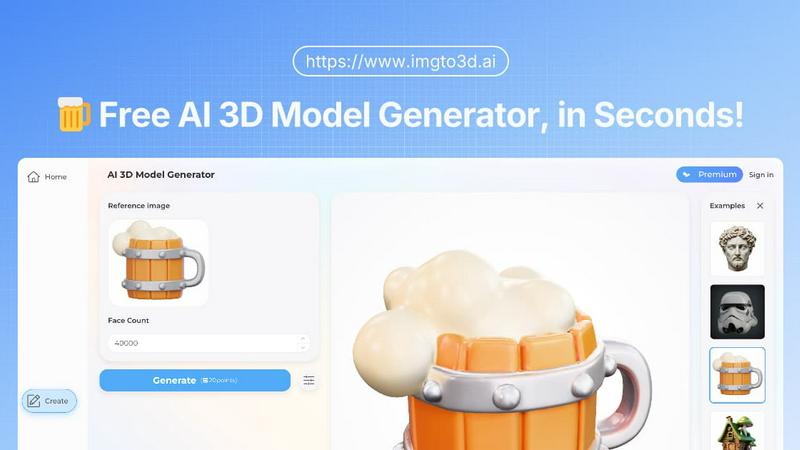
This core feature represents a true collaboration between your input and our AI. Simply upload a clear 2D image, and our cutting-edge algorithm works alongside your vision to construct a detailed, textured 3D model instantly. It intelligently interprets depth, form, and surface details, allowing your team to move from concept to tangible asset without the technical bottleneck of traditional modeling.
Multi-Format Export for Seamless Workflows
To ensure synergy across your entire production pipeline, Image to 3D AI provides textured model exports in OBJ, GLB, and STL formats. This versatility means your generated assets can be effortlessly handed off and integrated into game engines like Unity, AR/VR experiences, or sent directly to 3D printing software, facilitating smooth cooperation between design, development, and production teams.
Adaptive Polygon Density Control
Effective collaboration means giving every team member the right tools for their specific need. Our platform allows you to adjust the polygon count of your generated model, from 5K to 40K faces. This shared control enables your team to optimize assets for performance in resource-constrained environments like mobile games or for high-detail in cinematic renders, ensuring quality and efficiency are balanced collaboratively.
Permanently Free Generator with Pro Access
We believe in lowering the barrier to entry for collaborative creation. Our free tier requires no sign-up or credit card, inviting entire teams to experiment and prototype together at zero cost. For studios requiring stable, queue-free access and advanced exports, our Pro plan provides the reliable, high-volume infrastructure needed for professional, team-oriented projects without limitations.
LLMWise
Intelligent Model Routing
LLMWise's smart routing acts as your AI conductor, analyzing each prompt and automatically directing it to the most suitable model from its vast catalog. This means code generation tasks are sent to the best coding model, creative briefs to the most eloquent writer, and analytical questions to the most logical reasoner. This feature removes the guesswork and manual switching between different provider dashboards, allowing your team to focus on building great products instead of managing AI infrastructure.
Compare, Blend, and Judge Modes
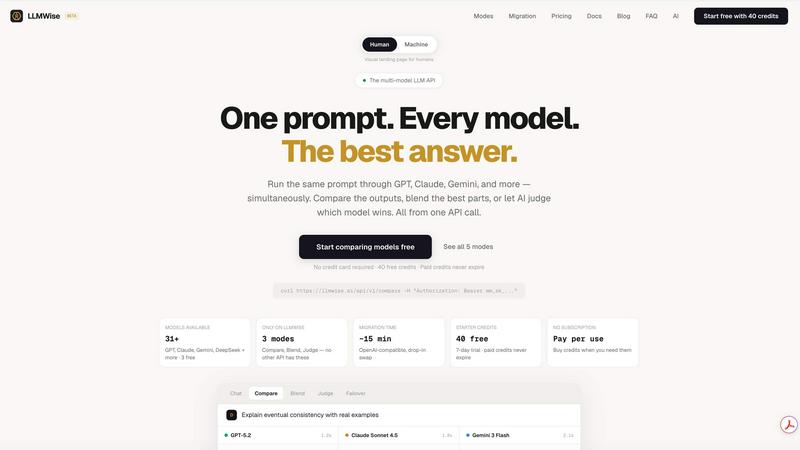
This suite of orchestration tools empowers teams to harness the collective intelligence of multiple models. Compare mode runs a single prompt across several models simultaneously, presenting their answers side-by-side with metrics on speed, cost, and length for easy evaluation. Blend mode takes this further by synthesizing the best parts of each model's output into one superior, cohesive answer. Judge mode enables models to critique and evaluate each other's responses, providing an automated layer of quality assurance.
Resilient Circuit-Breaker Failover
LLMWise ensures your application's AI capabilities never break. It includes an intelligent circuit-breaker system that monitors all connected providers in real-time. If a primary model or provider experiences high latency or an outage, traffic is instantly and automatically rerouted to a predefined backup model. This built-in redundancy guarantees high availability and reliability for production applications, giving your team and your users uninterrupted service.
Advanced Testing & Optimization Suite
Teams can systematically improve their AI implementations with LLMWise's built-in testing tools. Create benchmark suites and run batch tests across models to measure performance on your specific prompts. Set optimization policies that automatically prioritize speed, cost, or accuracy for different types of requests. Automated regression checks help ensure that updates to models or prompts don't degrade the quality of your outputs, fostering a culture of continuous improvement and stable deployments.
Use Cases
Image to 3D AI
Accelerated Game Development
Game development teams can achieve remarkable synergy by using Image to 3D AI for rapid prototyping and asset creation. Generate characters, props, and environment pieces in minutes instead of days. This allows artists, designers, and developers to collaborate more effectively, iterating on concepts and populating game worlds with high-quality, performance-optimized models at an unprecedented pace.
Streamlined 3D Printing Projects
From hobbyist communities to professional startups, collaborators in 3D printing can streamline their design process. Transform sketches or photos of custom figurines, practical objects, or architectural models into printable STL files. This shared tool accelerates the journey from a collective idea to a physical prototype, making iterative design and production a more cohesive team effort.
Efficient XR/VR Content Creation
For teams building immersive virtual and augmented reality experiences, quickly generating optimized assets is crucial. Our tool allows XR producers and 3D artists to work in tandem to rapidly populate virtual worlds with detailed models. The polygon control ensures assets perform well, helping technical and creative teams collaborate to maintain high frame rates without sacrificing visual fidelity.
Dynamic Creative Portfolio Building
Artists, designers, and students can work collaboratively with AI to build and enhance their portfolios. The ability to quickly convert concepts and drawings into presentable 3D models enables rapid iteration and exploration of ideas. This synergy allows creators to demonstrate a wider range of skills and completed projects, showcasing their vision and technical adaptability in a team-oriented context.
LLMWise
Development and Prototyping
Developers can rapidly prototype AI features using the 30 permanently free models available at zero cost. This allows teams to experiment with different model capabilities, test prompt effectiveness, and build proof-of-concepts without any financial commitment. The compare mode is invaluable for debugging prompt issues by instantly seeing how different models interpret the same instruction, saving hours of trial and error.
Production Application Resilience
For teams running customer-facing AI applications, LLMWise's failover routing is critical. It ensures that if a primary AI service like GPT-4 has an outage, user requests are seamlessly handled by a backup model like Claude or Gemini, preventing downtime and maintaining a positive user experience. This turns a potential crisis into a minor, automated blip that your operations team doesn't need to manually manage.
Cost-Optimized AI Operations
Companies with existing API credits from major providers can use LLMWise's BYOK (Bring Your Own Keys) feature to plug in their keys and immediately benefit from smart routing and failover without changing their billing setup. This synergy between existing investments and new orchestration capabilities can lead to significant cost reductions, often over 40%, by ensuring the most cost-effective model is used for each task.
Content Creation and Evaluation
Marketing and content teams can use the blend and judge modes to produce higher-quality drafts. A single request can generate variations from multiple creative models, then synthesize the strongest elements into a final piece. Judge mode can then provide automated feedback on tone, clarity, and alignment with brand guidelines, creating a collaborative workflow between human creativity and AI assistance.
Overview
About Image to 3D AI
Image to 3D AI, by ImgTo3D.ai, is a collaborative platform that empowers creators to work in synergy with advanced artificial intelligence, transforming the solitary task of 3D modeling into a streamlined, team-friendly process. This web-based tool is designed for a diverse community of innovators, including indie game developers, 3D printing enthusiasts, e-commerce entrepreneurs, and XR producers. It revolutionizes digital asset creation by converting a single 2D image, photo, or hand-drawn sketch into a fully textured 3D model in mere seconds. The core value proposition is a powerful partnership between human creativity and AI efficiency: it eliminates the traditional, time-intensive barriers of manual 3D modeling, slashing prototyping costs by up to 90% and accelerating asset creation workflows by 8x. By offering a permanently free tier with no software installation or sign-up required, Image to 3D AI fosters an inclusive environment where teams and solo creators can rapidly iterate, prototype, and bring their collective visions to life for gaming, virtual reality, augmented reality, and 3D printing applications.
About LLMWise
LLMWise is the ultimate orchestration platform for developers and teams building with large language models. It eliminates the complexity of managing multiple AI providers by offering a single, unified API to access over 62 models from 20 leading providers, including OpenAI, Anthropic, Google, Meta, xAI, and DeepSeek. The core value proposition is intelligent, task-based routing: you send a prompt, and LLMWise automatically selects the optimal model for the job, whether it's coding with GPT, creative writing with Claude, or translation with Gemini. This collaborative approach ensures you always get the best possible output without vendor lock-in.
Built for developers who demand performance and reliability, LLMWise goes beyond simple routing with powerful orchestration modes like side-by-side comparison, output blending, and model-judged evaluations. It ensures your applications are always resilient with automatic failover routing if a provider experiences downtime. With a flexible, credit-based pricing model and the option to bring your own API keys (BYOK), teams can significantly reduce costs while gaining unparalleled flexibility. Start with 20 free credits and access 30 permanently free models to prototype, test, and build with zero commitment.
Frequently Asked Questions
Image to 3D AI FAQ
Is Image to 3D AI really free to use?
Yes, absolutely. We offer a permanently free tier to support collaborative creativity. You can generate 3D models from images without any sign-up, software installation, or credit card required. This free vision is designed to meet the needs of most users and teams for prototyping and personal projects. During peak hours, free users may experience processing queues to ensure service quality for everyone.
What image formats and types work best?
Our AI 3D model generator works best with clear, well-lit images of single objects. You can upload common formats like JPG, PNG, or WebP. For optimal results that foster a good partnership with the AI, use images with good contrast, minimal background clutter, and a clear focal point on the subject you wish to convert into a 3D model.
What 3D file formats can I export?
The free generator provides downloads in the widely compatible OBJ format. For teams working across advanced pipelines, our Pro access unlocks textured exports in multiple formats including OBJ, GLB (for web and real-time applications), and STL (for 3D printing). This ensures your team's output can integrate seamlessly into the next stage of your collaborative project.
How does the polygon density (face count) setting work?
The face count slider (from 5K to 40K) allows your team to collaboratively decide on the detail level versus performance needs of your asset. A lower polygon count creates lighter, more performance-friendly models ideal for mobile games or VR. A higher count preserves finer details for closer inspection or rendering. This shared control puts the optimization decision in your team's hands.
LLMWise FAQ
How does the pricing work?
LLMWise uses a simple, pay-as-you-go credit system with no monthly subscriptions. You start with 20 free trial credits that never expire. After that, you purchase credit packs. You are only charged credits when you use a paid model; the 30 free models always cost 0 credits. You also have the option to use your own existing API keys from providers (BYOK), in which case you pay the provider directly at their rates and only use LLMWise credits for the orchestration features.
What are the free models for?
The 30+ free models serve multiple strategic purposes. They are perfect for initial prototyping and development, allowing you to build and test without cost. They act as a smart fallback layer for non-critical traffic or during retries if paid models fail. They are also essential for benchmarking, enabling you to compare the quality and performance of free versus paid models on your specific tasks before deciding where to route production traffic.
How quickly can I integrate LLMWise?
You can be up and running in under two minutes. The process involves signing up for an account to receive your free credits, generating a single API key from your dashboard, and then making your first request using the provided Python/TypeScript SDKs or cURL examples. This unified API approach means you replace multiple provider-specific integrations with one simple connection.
What happens if a model provider is down?
LLMWise's circuit-breaker failover system handles this automatically. The platform continuously monitors the health and latency of all connected model providers. If a primary model becomes unavailable or too slow, the system instantly reroutes your application's requests to a pre-configured backup model from a different provider. This ensures your application's AI features remain operational without any manual intervention required from your team.
Alternatives
Image to 3D AI Alternatives
ImgTo3D.ai is a powerful AI assistant that transforms 2D images into 3D models, offering creators a fast and accessible entry point into 3D content creation. It streamlines workflows for game development, AR/VR, and 3D printing by converting a simple photo into a textured model in seconds. Users often explore other options to find the perfect collaborative fit for their specific project ecosystem. This search might be driven by the need for different pricing structures, specialized features for animation or sculpting, integration with particular software pipelines, or requirements for higher-resolution outputs and more granular control over the generation process. When evaluating different tools, it's wise to consider how they align with your team's goals. Key factors include the supported 3D file formats for seamless integration, the level of manual editing possible after generation, the scalability of pricing, and the overall quality and consistency of the AI's output for your intended use case.
LLMWise Alternatives
LLMWise is a unified API platform in the AI assistants category, designed to give developers a single access point to leading large language models like GPT, Claude, and Gemini. Its core innovation is intelligent auto-routing, which automatically selects the best-suited model for each specific prompt to optimize performance. Users often explore alternatives for various reasons, such as different pricing structures, the need for specific platform integrations, or a desire for a different set of management and testing features. Some teams may prioritize a different balance between cost, control, and convenience. When evaluating other solutions, it's wise to consider your team's primary needs. Key factors include the flexibility of the API, the depth of analytics and testing tools, the robustness of failover systems, and the overall pricing model. The goal is to find a tool that enhances your team's collaborative workflow without adding unnecessary complexity.