HookMesh vs LLMWise
Side-by-side comparison to help you choose the right product.

Effortlessly enhance your SaaS with reliable webhooks, automatic retries, and a self-service customer portal.
Last updated: February 28, 2026

Unify your team's AI tools with one smart API that automatically picks the best model for every task.
Last updated: February 28, 2026
Visual Comparison
HookMesh
LLMWise
Feature Comparison
HookMesh
Reliable Delivery
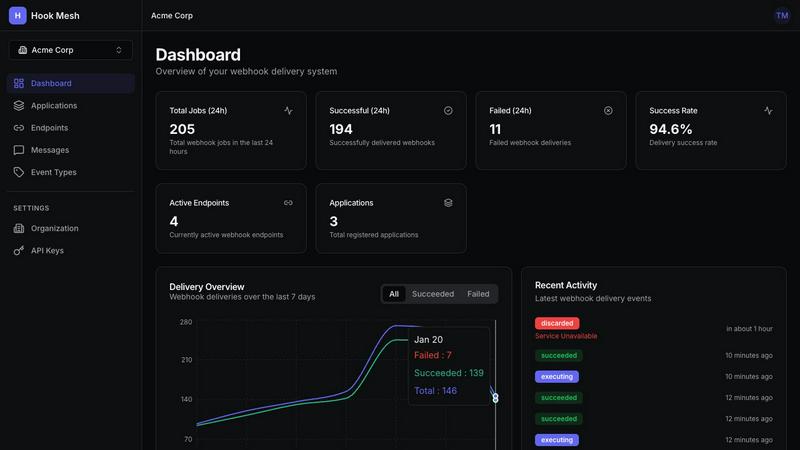
HookMesh guarantees that webhook events are never lost, thanks to its automatic retry mechanism. It employs exponential backoff with jitter, retrying up to 48 hours to ensure successful delivery. This feature is instrumental in maintaining robust communication between your application and your users.
Circuit Breaker
The circuit breaker feature automatically disables failing endpoints and re-enables them once they recover. This proactive approach minimizes the risk of a single slow customer endpoint affecting the entire queue, ensuring that webhook deliveries remain uninterrupted.
Customer Portal
The embedded customer portal offers a self-service solution for users to manage their endpoints effortlessly. It provides delivery logs for full request and response visibility, allowing users to trace and troubleshoot delivery issues effectively. The one-click replay option also enhances user experience by enabling instant retries for failed deliveries.
Developer Experience
HookMesh is built with developers in mind, featuring a comprehensive REST API and SDKs for popular programming languages such as JavaScript, Python, and Go. This makes it incredibly easy to integrate webhook functionality into applications with just a few lines of code, allowing teams to ship webhooks in minutes.
LLMWise
Intelligent Model Routing
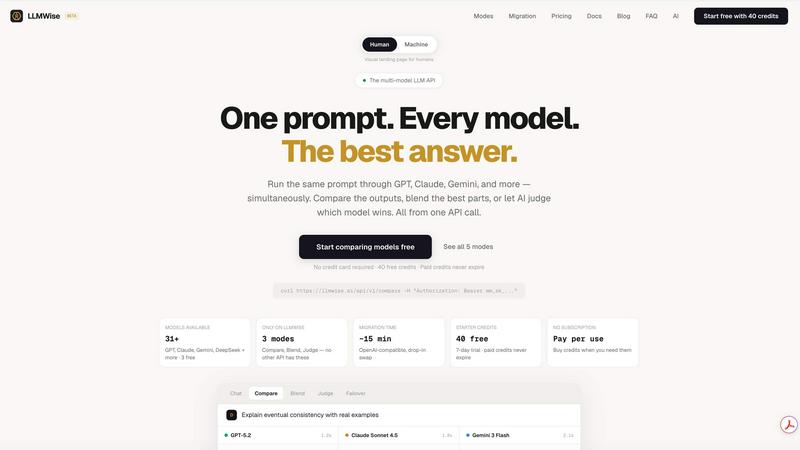
LLMWise's smart routing acts as your AI conductor, analyzing each prompt and automatically directing it to the most suitable model from its vast catalog. This means code generation tasks are sent to the best coding model, creative briefs to the most eloquent writer, and analytical questions to the most logical reasoner. This feature removes the guesswork and manual switching between different provider dashboards, allowing your team to focus on building great products instead of managing AI infrastructure.
Compare, Blend, and Judge Modes
This suite of orchestration tools empowers teams to harness the collective intelligence of multiple models. Compare mode runs a single prompt across several models simultaneously, presenting their answers side-by-side with metrics on speed, cost, and length for easy evaluation. Blend mode takes this further by synthesizing the best parts of each model's output into one superior, cohesive answer. Judge mode enables models to critique and evaluate each other's responses, providing an automated layer of quality assurance.
Resilient Circuit-Breaker Failover
LLMWise ensures your application's AI capabilities never break. It includes an intelligent circuit-breaker system that monitors all connected providers in real-time. If a primary model or provider experiences high latency or an outage, traffic is instantly and automatically rerouted to a predefined backup model. This built-in redundancy guarantees high availability and reliability for production applications, giving your team and your users uninterrupted service.
Advanced Testing & Optimization Suite
Teams can systematically improve their AI implementations with LLMWise's built-in testing tools. Create benchmark suites and run batch tests across models to measure performance on your specific prompts. Set optimization policies that automatically prioritize speed, cost, or accuracy for different types of requests. Automated regression checks help ensure that updates to models or prompts don't degrade the quality of your outputs, fostering a culture of continuous improvement and stable deployments.
Use Cases
HookMesh
E-commerce Notifications
E-commerce platforms can use HookMesh to notify customers about order status updates, such as confirmations and shipping notifications. Reliable webhook delivery ensures that customers receive timely information, enhancing their shopping experience and improving engagement.
Payment Processing
Payment processing systems can leverage HookMesh to send payment confirmations and updates to their customers. By ensuring that these critical notifications are delivered reliably, businesses can enhance customer trust and satisfaction in their payment processes.
SaaS Integrations
SaaS products can utilize HookMesh for seamless integration with third-party applications. By providing consistent webhook delivery, businesses can ensure that data flows smoothly between platforms, thereby improving operational efficiency and user experience.
Event-Driven Applications
Developers building event-driven applications can implement HookMesh to manage and deliver event notifications. The platform's robust infrastructure allows for scalable webhook management, enabling teams to focus on building features rather than managing delivery logistics.
LLMWise
Development and Prototyping
Developers can rapidly prototype AI features using the 30 permanently free models available at zero cost. This allows teams to experiment with different model capabilities, test prompt effectiveness, and build proof-of-concepts without any financial commitment. The compare mode is invaluable for debugging prompt issues by instantly seeing how different models interpret the same instruction, saving hours of trial and error.
Production Application Resilience
For teams running customer-facing AI applications, LLMWise's failover routing is critical. It ensures that if a primary AI service like GPT-4 has an outage, user requests are seamlessly handled by a backup model like Claude or Gemini, preventing downtime and maintaining a positive user experience. This turns a potential crisis into a minor, automated blip that your operations team doesn't need to manually manage.
Cost-Optimized AI Operations
Companies with existing API credits from major providers can use LLMWise's BYOK (Bring Your Own Keys) feature to plug in their keys and immediately benefit from smart routing and failover without changing their billing setup. This synergy between existing investments and new orchestration capabilities can lead to significant cost reductions, often over 40%, by ensuring the most cost-effective model is used for each task.
Content Creation and Evaluation
Marketing and content teams can use the blend and judge modes to produce higher-quality drafts. A single request can generate variations from multiple creative models, then synthesize the strongest elements into a final piece. Judge mode can then provide automated feedback on tone, clarity, and alignment with brand guidelines, creating a collaborative workflow between human creativity and AI assistance.
Overview
About HookMesh
HookMesh is a cutting-edge solution designed to revolutionize webhook delivery for modern SaaS products. It tackles the complexities that arise from building webhooks in-house, allowing businesses to concentrate on their core competencies rather than getting mired in technical challenges. With features like automatic retries, circuit breakers, and robust debugging tools, HookMesh empowers developers and product teams to deliver a seamless experience to their users. Its battle-tested infrastructure ensures that webhook events are consistently reliable and delivered on time. By providing a self-service portal, HookMesh enables customers to manage their endpoints easily, view delivery logs, and even replay failed webhooks with a single click. This makes HookMesh the ideal choice for organizations that seek to simplify their webhook strategy while ensuring peace of mind and operational efficiency.
About LLMWise
LLMWise is the ultimate orchestration platform for developers and teams building with large language models. It eliminates the complexity of managing multiple AI providers by offering a single, unified API to access over 62 models from 20 leading providers, including OpenAI, Anthropic, Google, Meta, xAI, and DeepSeek. The core value proposition is intelligent, task-based routing: you send a prompt, and LLMWise automatically selects the optimal model for the job, whether it's coding with GPT, creative writing with Claude, or translation with Gemini. This collaborative approach ensures you always get the best possible output without vendor lock-in.
Built for developers who demand performance and reliability, LLMWise goes beyond simple routing with powerful orchestration modes like side-by-side comparison, output blending, and model-judged evaluations. It ensures your applications are always resilient with automatic failover routing if a provider experiences downtime. With a flexible, credit-based pricing model and the option to bring your own API keys (BYOK), teams can significantly reduce costs while gaining unparalleled flexibility. Start with 20 free credits and access 30 permanently free models to prototype, test, and build with zero commitment.
Frequently Asked Questions
HookMesh FAQ
What is HookMesh?
HookMesh is a webhook delivery solution that simplifies and enhances the process of delivering webhook events for modern SaaS products, helping businesses focus on their core offerings.
How does HookMesh ensure reliable delivery?
HookMesh employs automatic retries, exponential backoff, and circuit breakers to guarantee that webhook events are delivered reliably and efficiently, even in the face of endpoint failures.
Can customers manage their own webhook endpoints?
Yes, HookMesh provides a self-service portal where customers can easily manage their webhook endpoints, view delivery logs, and replay failed webhook deliveries with just one click.
What programming languages does HookMesh support?
HookMesh offers SDKs for popular programming languages including JavaScript, Python, and Go, making it easy for developers to integrate webhook functionality into their applications.
LLMWise FAQ
How does the pricing work?
LLMWise uses a simple, pay-as-you-go credit system with no monthly subscriptions. You start with 20 free trial credits that never expire. After that, you purchase credit packs. You are only charged credits when you use a paid model; the 30 free models always cost 0 credits. You also have the option to use your own existing API keys from providers (BYOK), in which case you pay the provider directly at their rates and only use LLMWise credits for the orchestration features.
What are the free models for?
The 30+ free models serve multiple strategic purposes. They are perfect for initial prototyping and development, allowing you to build and test without cost. They act as a smart fallback layer for non-critical traffic or during retries if paid models fail. They are also essential for benchmarking, enabling you to compare the quality and performance of free versus paid models on your specific tasks before deciding where to route production traffic.
How quickly can I integrate LLMWise?
You can be up and running in under two minutes. The process involves signing up for an account to receive your free credits, generating a single API key from your dashboard, and then making your first request using the provided Python/TypeScript SDKs or cURL examples. This unified API approach means you replace multiple provider-specific integrations with one simple connection.
What happens if a model provider is down?
LLMWise's circuit-breaker failover system handles this automatically. The platform continuously monitors the health and latency of all connected model providers. If a primary model becomes unavailable or too slow, the system instantly reroutes your application's requests to a pre-configured backup model from a different provider. This ensures your application's AI features remain operational without any manual intervention required from your team.
Alternatives
HookMesh Alternatives
HookMesh is a cutting-edge solution designed to optimize webhook delivery for software as a service (SaaS) applications. It helps users manage the intricacies of webhook management, such as retry logic and debugging, allowing teams to concentrate on their core offerings. As companies grow and evolve, they often seek alternatives to HookMesh for various reasons, including cost-effectiveness, specific feature requirements, and compatibility with their existing infrastructure. When searching for an alternative, consider factors such as the reliability of delivery mechanisms, ease of use, customer support options, and the ability to integrate seamlessly with your current systems. It’s also crucial to evaluate the user experience and self-service capabilities, as these can significantly impact your team's efficiency and overall satisfaction with the webhook management process.
LLMWise Alternatives
LLMWise is a unified API platform in the AI assistants category, designed to give developers a single access point to leading large language models like GPT, Claude, and Gemini. Its core innovation is intelligent auto-routing, which automatically selects the best-suited model for each specific prompt to optimize performance. Users often explore alternatives for various reasons, such as different pricing structures, the need for specific platform integrations, or a desire for a different set of management and testing features. Some teams may prioritize a different balance between cost, control, and convenience. When evaluating other solutions, it's wise to consider your team's primary needs. Key factors include the flexibility of the API, the depth of analytics and testing tools, the robustness of failover systems, and the overall pricing model. The goal is to find a tool that enhances your team's collaborative workflow without adding unnecessary complexity.