Coursebricks vs Tickari
Side-by-side comparison to help you choose the right product.
Coursebricks
Coursebricks unites your team to schedule, sell, and manage training seamlessly.
Last updated: March 1, 2026

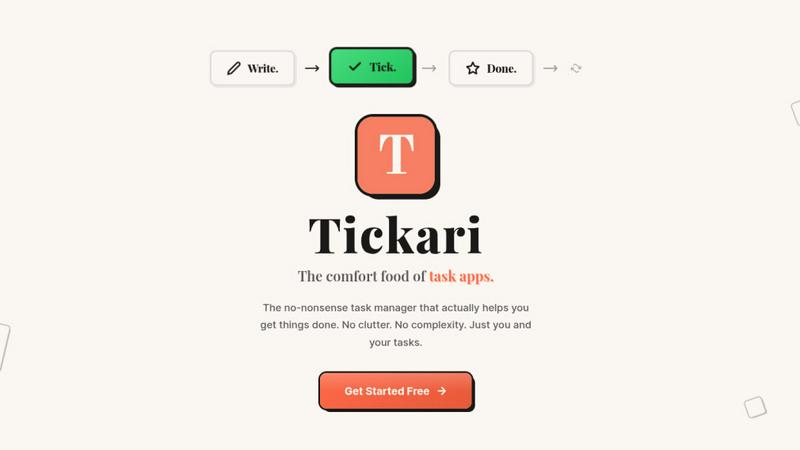
The no-nonsense task manager that actually helps you get things done. No clutter. No complexity. Just you and your tasks.
Visual Comparison
Coursebricks

Tickari
Overview
About Coursebricks
Coursebricks is the collaborative, all-in-one training management system designed to unify your team and streamline every aspect of your training operations. It's built for training organizations of all sizes—from growing businesses to large enterprises—that seek to replace fragmented tools and manual processes with a single, synergistic platform. By bringing together scheduling, registrations, payments, website management, CRM, email marketing, and reporting into one cohesive hub, Coursebricks empowers your entire team to work in concert. Instructors, administrators, and sales teams can collaborate seamlessly, ensuring nothing falls through the cracks. The core value proposition is clear: regain complete control and visibility over your training lifecycle. Publish courses directly to your own website, accept payments without platform fees, and automate communications to enhance the learner experience. With Coursebricks, your organization can focus its collective energy on delivering exceptional education, scaling efficiently, and driving growth, all from one accessible location that keeps everyone on the same page.
About Tickari
Tickari is a deliberately minimal, no-nonsense task manager designed for people who are tired of overcomplicated productivity tools and just want to get things done. Instead of overwhelming you with features like complex boards, AI-generated suggestions, or endless customization, Tickari focuses on a simple, frictionless workflow: write a task, tick it off, and move on.
The product embraces a “less but better” philosophy—eliminating clutter, reducing cognitive overhead, and removing the need for onboarding tutorials or setup processes. There are no distractions, no unnecessary decisions, and no feature bloat—just a clean interface that works instantly the moment you open it. This makes it particularly effective for users who feel stuck organizing tasks instead of actually completing them.