Collab Chain vs Tickari
Side-by-side comparison to help you choose the right product.

Collab Chain turns royalty statements into secure proof of collaboration and ownership, ensuring transparency and trust.
Last updated: February 28, 2026

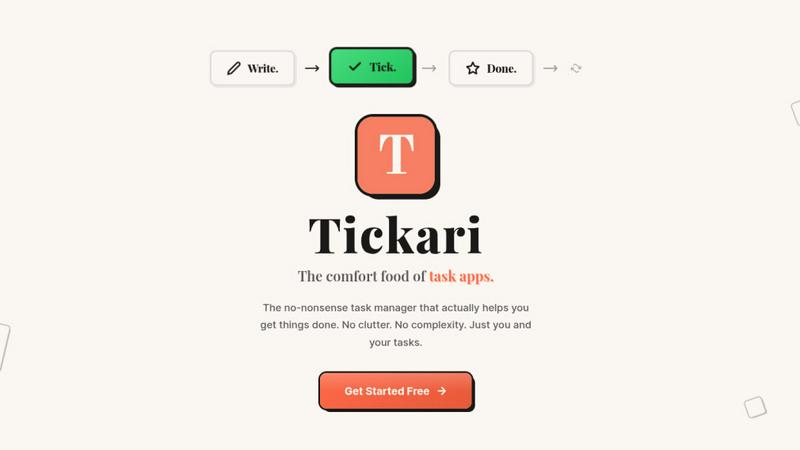
The no-nonsense task manager that actually helps you get things done. No clutter. No complexity. Just you and your tasks.
Visual Comparison
Collab Chain

Tickari
Overview
About Collab Chain
Collab Chain is a revolutionary platform designed to provide royalty verification and collaboration proof specifically for creators, producers, songwriters, and rights holders in the music industry. The platform addresses the persistent issues of ownership clarity and trust, which are often prevalent in creative collaborations. By allowing users to upload official royalty statements, splits, and credit documents from a variety of sources including distributors, performing rights organizations (PROs), and publishers, Collab Chain meticulously parses and normalizes this data. This results in clear, structured records that serve as reliable, verifiable proof of contribution and royalty entitlement. The main value proposition lies in fostering transparency, minimizing disputes, and creating a trustworthy source of truth regarding ownership history. With Collab Chain acting as a secure credit locker, creators can confidently negotiate, audit, or resolve conflicts, knowing they have the necessary documentation at their disposal. This makes Collab Chain an indispensable tool for independent artists, labels, managers, and legal teams who require defensible records in a complex industry.
About Tickari
Tickari is a deliberately minimal, no-nonsense task manager designed for people who are tired of overcomplicated productivity tools and just want to get things done. Instead of overwhelming you with features like complex boards, AI-generated suggestions, or endless customization, Tickari focuses on a simple, frictionless workflow: write a task, tick it off, and move on.
The product embraces a “less but better” philosophy—eliminating clutter, reducing cognitive overhead, and removing the need for onboarding tutorials or setup processes. There are no distractions, no unnecessary decisions, and no feature bloat—just a clean interface that works instantly the moment you open it. This makes it particularly effective for users who feel stuck organizing tasks instead of actually completing them.